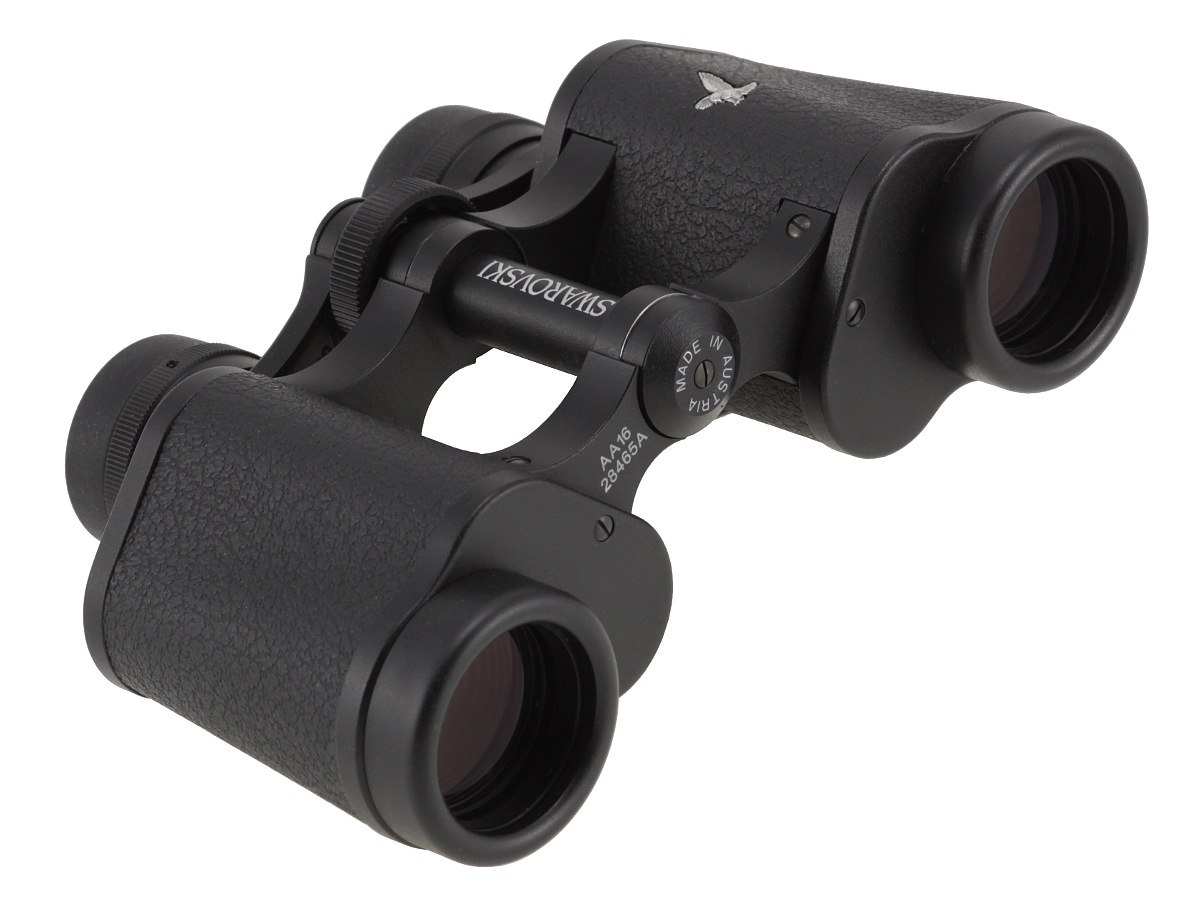
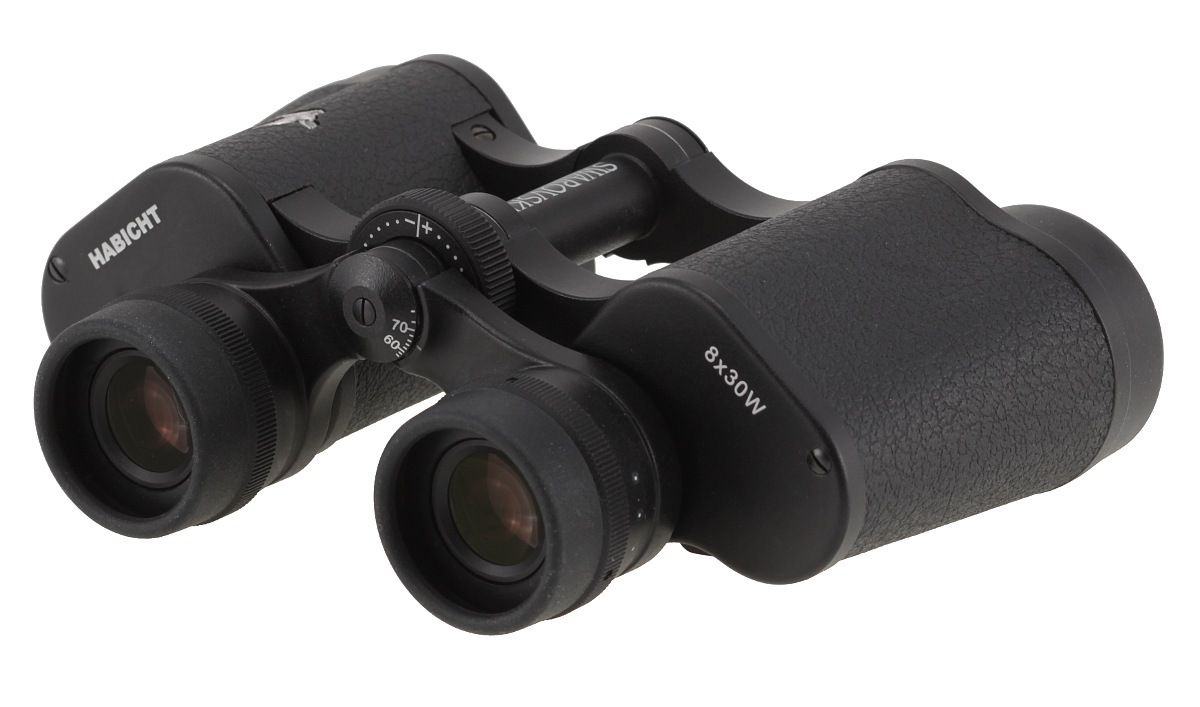
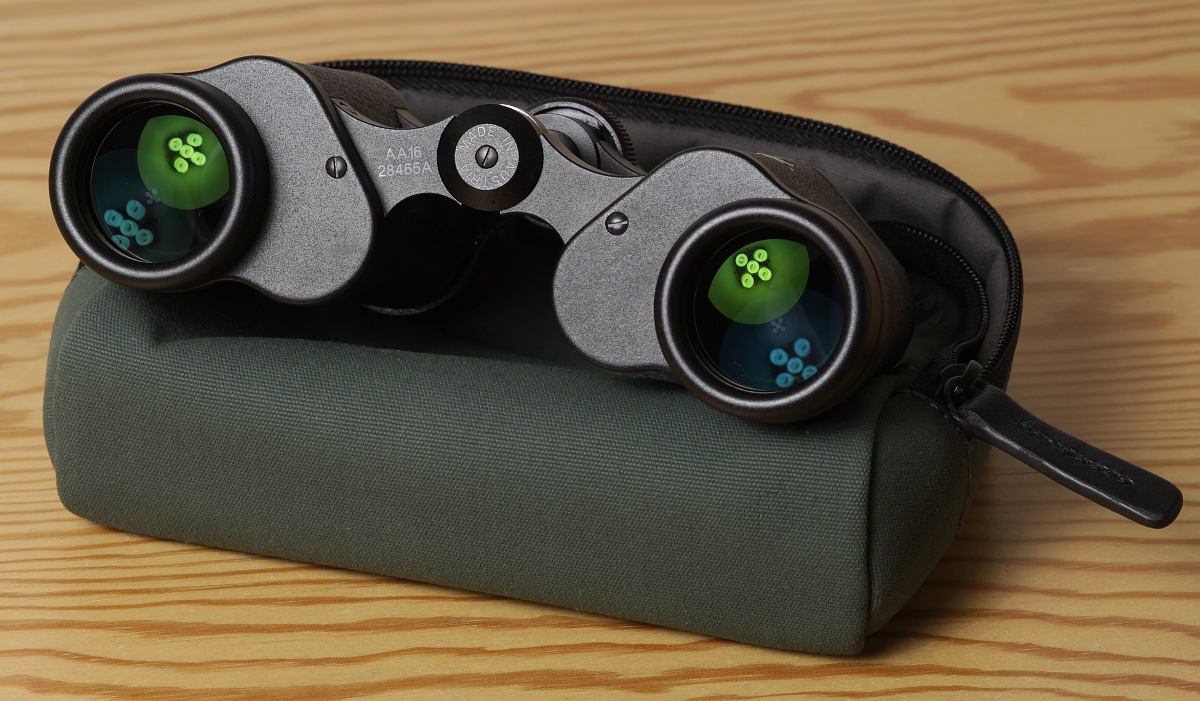
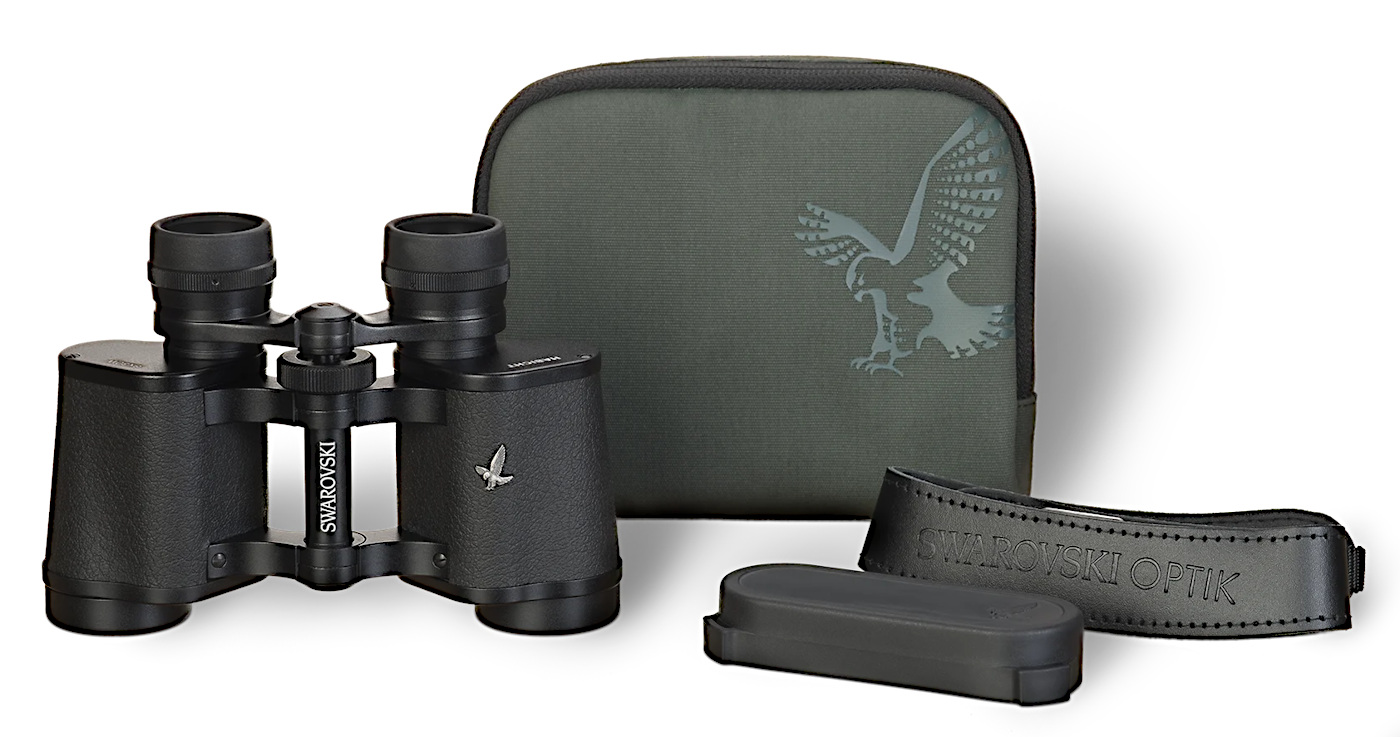
In 1994 Swarovski carried out further modifications of the external appearance and parameters. The Habicht 8x30 W started to look like a model we see in shops today. The faux leather texture became more delicate and stylish. On the left tube they put the logo of the company in a shape of a hawk with outstretched wings and SWAROVSKI inscription was moved to the central bridge. Inscriptions on the prism barrels were simplified – on the left you got just HABICHT, on the right only the parameters. The serial number was on an arm of the bridge, an inscription Made in Austria flowed elegantly across an archway.
As if it wasn't enough, the producers once again changed the field of view. In catalogues from the second half of 1990s you saw 7.8 deg, a value that remains up to now. The eye relief distance still amounted 12 mm and the minimum focusing distance – 3 meters.
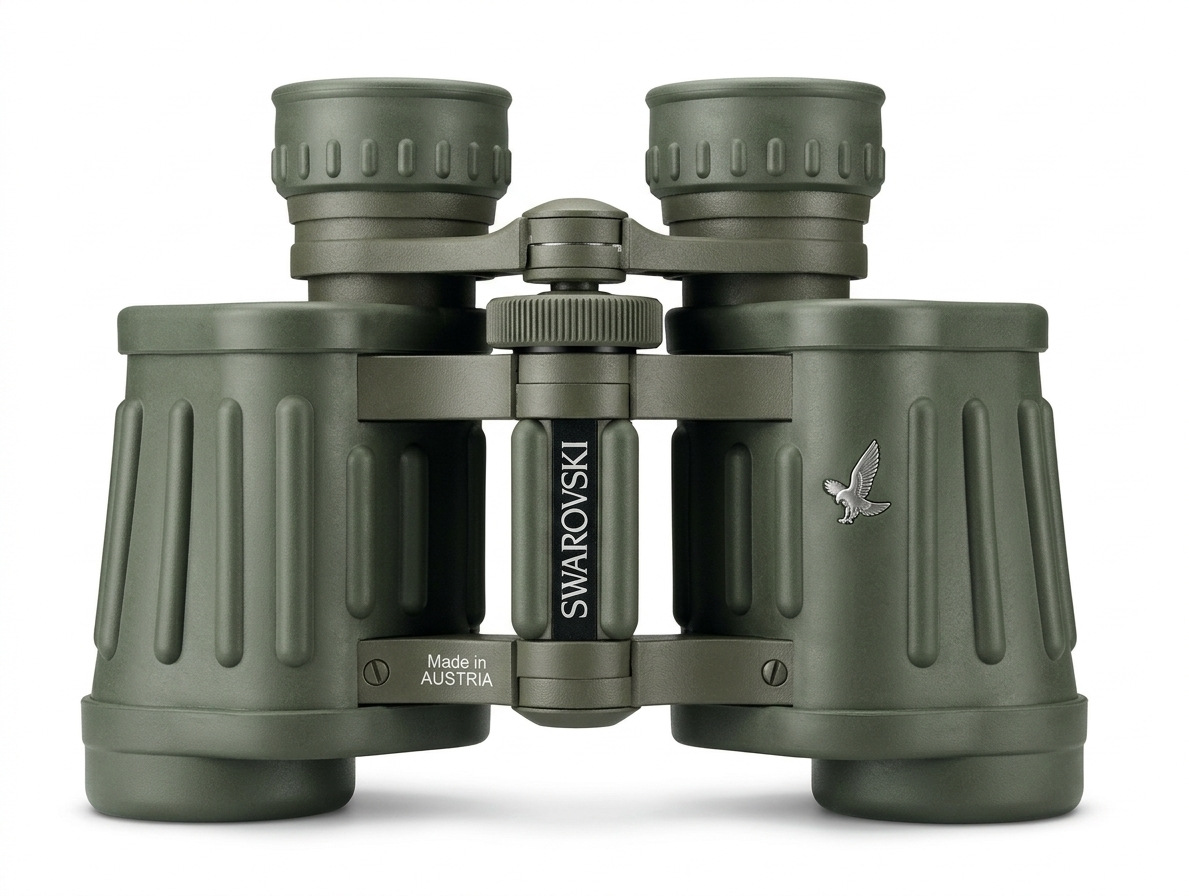
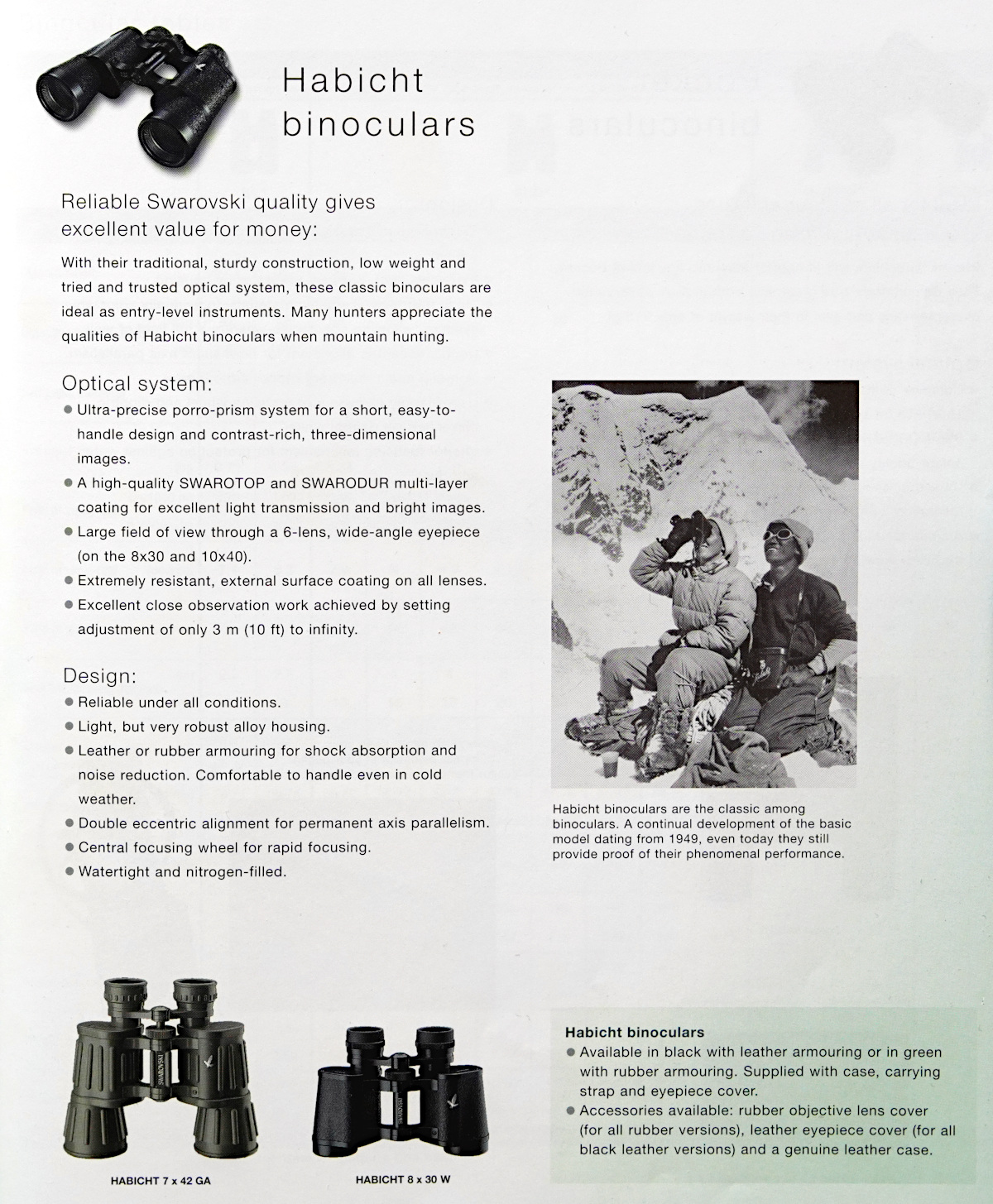
It seems that in this period of time they stopped to produce a leather-padded version completely that came with an individual focusing system. When it comes to rubber armour variants, the model with a central focusing was still present in the 2003 catalogue, and disappeared later. The rubber armour model with individual focusing appeared sporadically in small batches – last time I saw it was in 2024.
Please Support Us
If you enjoy our reviews and articles, and you want us to continue our work please, support our website by donating through PayPal. The funds are going to be used for paying our editorial team, renting servers, and equipping our testing studio; only that way we will be able to continue providing you interesting content for free.
- - - - - - - - - - - - - - - - - - R E K L A M A - - - - - - - - - - - - - - - - - -
Swarovski Habicht 8x30 W M GA binoculars manufactured between 1994-2003.
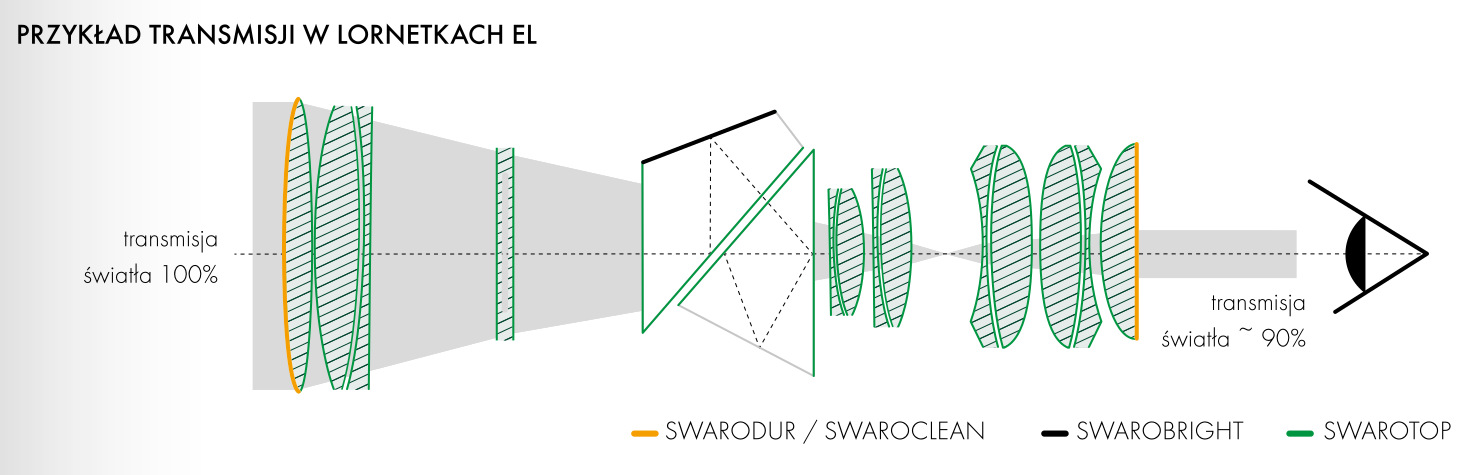
Anti-reflection Swarotop multi coatings have been changed and improved constantly. They covered all air-to-glass surfaces inside the binoculars. At the same time, near the end of 1990s, they added new coatings called Swarodur that covered only outer optical elements.
Coatings are difficult to create and here Swarovski Optik became a leader. Their brand name coatings might have even 120 layers, each of them as thick as just several nanometers (so 250 thinner than a human hair). They are able to reduce loss of light on one air-to-glass surface to just 0.2%. For comparison's sake – on any air-to-glass surface not covered by anything the loss of light amounts to 5%; if you employ just single coatings you are able to reduce that loss to about 1.5%.
Optical diagram of the EL series binoculars showing the arrangement of individual anti-reflection coating types.
The technological advances led to a clear declaration of the producer concerning the transmission that, in case of Habicht binoculars, is supposed to amount to as much as 96%. It is a brilliant result, completely off-limits to contemporary rivals with roof prisms. By the way it is a value completely real. After all in the 8x30 W model you deal with 10 air-to-glass surfaces (an achromat in the objective lens, glued Porro prisms and an eyepiece with 6 elements put into 3 groups). If you assume that top-of-the-range anti-reflection coatings, a trademark of Swarovski Optik, lose on one air-to-glass surface about 0.2% of light with ten surfaces the transmission will be 0.998 power of ten so 98%. You get about 2% to spare for glass absorbing of light and other effects connected to e.g a different efficiency of coatings on different types of glass and their decreasing efficiency with the increase of angle of incidence of light.
It is worth adding that the diagram shown above illustrates two additional types of coatings- Swarobright and Swaroclean - which are not used in the Habicht series. The former is straightforward: these are reflective coatings required in a Schmidt-Pechan prism system, making them completely redundant in a Porro prism system. Swaroclean, on the other hand, consists of coatings applied to the outer lens surfaces to repel dirt and moisture and make cleaning the optics easier. While these are undeniable benefits, there are also drawbacks. The application of these coatings slightly reduces light transmission, which may well be why they were omitted from the Habicht line, where high transmission is a key selling point meant to set this series apart in the market.
Page from a January 2003 Swarovski Optik catalog featuring the Habicht series models.
In this period there were also changes in the standard equipment. The producers left the plastic rainguard and a stylish, leather neck strap. The leather hard case was replaced by a soft bag made of cloth. The bag is comfortable and looks neat but I think leather fitted this classic series better. I suppose environmental and economic arguments prevailed.