


Review of four high-end 10x30 binoculars
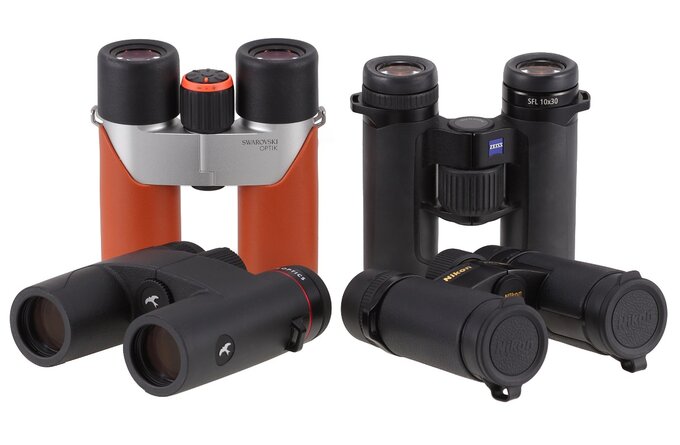
1. Kite Lynx HD+ vs Nikon Monarch HG vs Swarovski CL Companion III vs Zeiss SFL
Introduction
Our previous comparative test featuring four 8x30 binoculars met with a warm reception from you, which prompted me to continue this type of coverage. An opportunity for a new piece presented itself naturally, as many of you had been suggesting a review of the Zeiss SFL 10x30 - a model I happen to have on hand, as it is used by my wife.
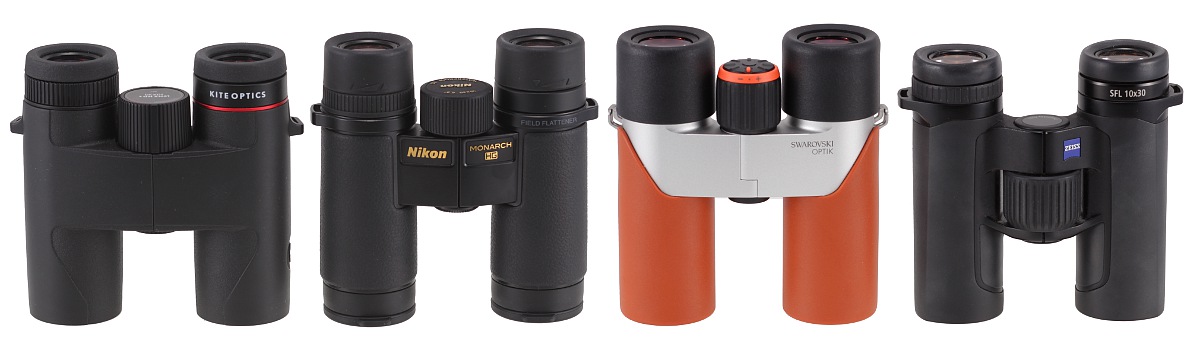
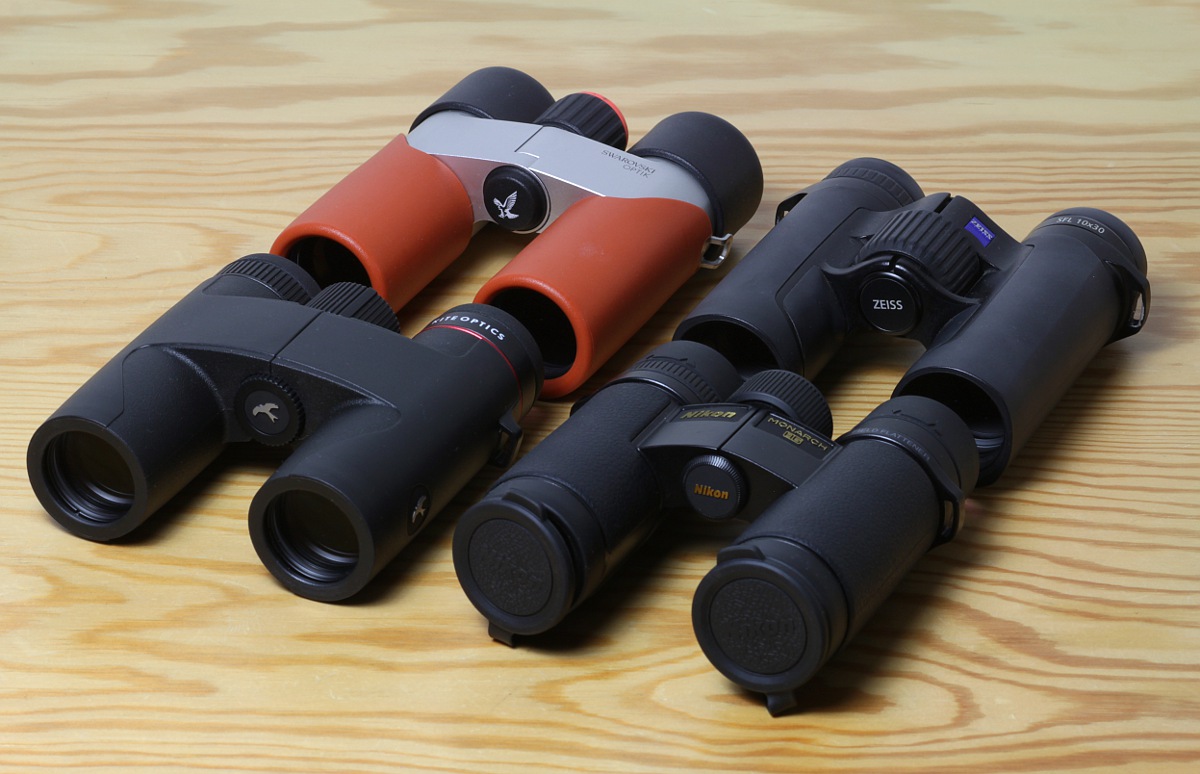
Since the SFL 10x30 is a top-tier, high-end model priced around 1500 Euro, it was only fitting to match it with worthy contenders. I decided to source three other 10x30 binoculars positioned in the upper price segment for this category. Listed alphabetically, they are: the Kite Lynx HD+ 10x30, priced at approximately 700 Euro and supplied for testing by
Focus Nordic; the Nikon Monarch HG 10x30, retailing for around 900 Euro; and the third-generation Swarovski CL Companion 10x30, valued at roughly 1500 Euro. The latter two were provided by the Beafoto.pl store.
A full parameter comparison of all tested binoculars is available in the main table, with an abridged version shown below.
Please Support UsIf you enjoy our reviews and articles, and you want us to continue our work please, support our website by donating through PayPal. The funds are going to be used for paying our editorial team, renting servers, and equipping our testing studio; only that way we will be able to continue providing you interesting content for free. |
- - - - - - - - - - - - - - - - - - - - - - - - - - - - - - - - - - - - - - - - - - - - - - - -
| Parameter | Kite Lynx HD+ 10x30 | Nikon Monarch HG 10x30 | Swarovski CL Companion 10x30 III | Zeiss SFL 10x30 |
|---|---|---|---|---|
| Field of view (°) | 6.9 | 6.9 | 6.6 | 6.9 |
| Eye relief (mm) | 15 | 15.2 | 18 | 18 |
| Min. focusing dist. (m) | 1.3 | 2 | 3 | 1.5 |
| Weight (g) | 499 | 450 | 550 | 460 |
| Size (mm) | 117 x 115 | 126 x 119 | 129 x 113 | 120 x 107 |
| Price [EUR] | 700 | 900 | 1490 | 1420 |
When it comes to the scoring system, I decided to borrow and slightly adapt the approach introduced by my colleague Holger Merlitz. Each test category will feature a ranking where the winner receives 4 points and the lowest-performing model gets 1 point. I realize this is a simplified system, but it will certainly suffice for a baseline assessment.
 |
- Specifications - since we aim to select binoculars with identical basic specs for these comparative tests, the key focus here will be comparing other essential features such as weight, dimensions, eye relief, and minimum focusing distance.
- Build quality and finish - the objective here is straightforward. We assess the overall build quality, the materials used for finishing, internal blackening and cleanliness, as well as the mechanical operation of individual components.
- Field of view - it's one of the most important parameters so I feel it deserves to be assessed separately.
- Image resolution - in this case we assess sharpness in the centre and on the edge of the field of view and also diaphragm cutoff.
- White balance and contrast - here we check whether the binoculars is able to produce natural colours and what its global image contrast is.
- Chromatic aberration - in this category we assess chromatic aberration correction in the centre and on edges of the field of view.
- Distortion - we assess geometric deformation of images, checking where it appears and how pronounced it is.
- Night tests - we use stars for these tests, checking astigmatism, coma, and brightness loss on the edge of the field. We decided to gather all these features in just one category.
- Ghosting and flares - we check the appearance of area close to the exit pupil, the performance against bright source of light (both during the day against the sun and at night, looking at bright lampposts).
 |
Specifications
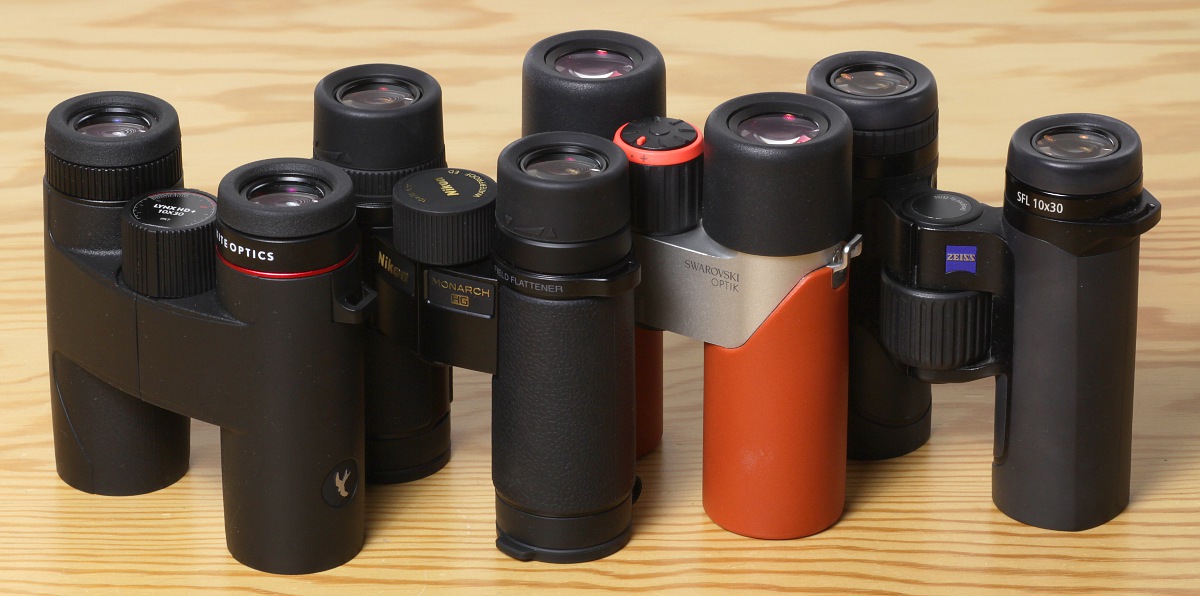
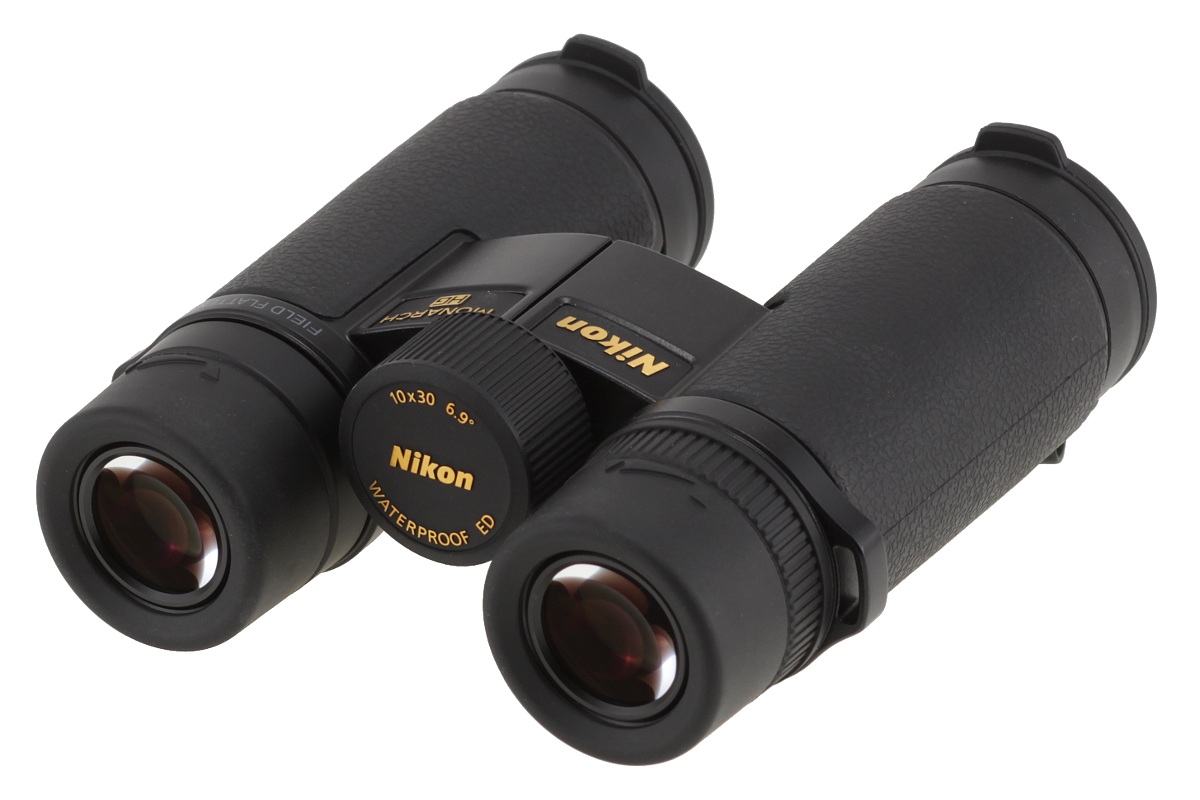
In this category, at first glance, there are two distinct groups. The Kite, Nikon, and Zeiss look small, lightweight, and neat, whereas the Swarovski gives the impression of being heavier and bulkier than its competitors. However, it is worth checking everything thoroughly and relying on actual measured values rather than visual impressions and manufacturer specs.
When it comes to weight, the Nikon Monarch HG 10x30 comes out on top, weighing in at just 460 grams. The Zeiss SFL 10x30 is only slightly heavier at 465 grams. According to the specifications, the weight of the Kite Lynx HD+ 10x30 was supposed to be 499 grams. That figure seemed a bit suspicious, almost as if someone was desperately trying to keep the binoculars in the sub-500-gram class. And indeed, reality is slightly less impressive, as the actual weight turns out to be 507 grams. While the difference isn't huge, it's a shame the manufacturer has to resort to petty tricks to inflate its specs. Bringing up the rear is the Swarovski CL Companion 10x30 III, with a real weight of 560 grams.
As for physical dimensions, we didn't rely on official specs here either. Manufacturers measure their binoculars in different ways and don't always specify how they do it. We measured length without lens caps and with the eyecups fully collapsed, while width was measured at maximum interpupillary distance. Under these conditions, the Zeiss fared best with dimensions of 119x114 mm. Second place went to the Kite (118x117 mm), closely followed by the Nikon (119x118 mm), with the Swarovski once again bringing up the rear (129x116 mm).
For binoculars this small, where the barrels can be brought very close together, the minimum focus distance is an important metric - if it is truly short, the binoculars can double as a pseudo-macro instrument. The Zeiss won this category as well, focusing down to around 1.35 meters. Second place went to the Nikon with a result of 1.45 meters, third to the Kite (1.55 meters), and last place went to the Swarovski once again, with a far from impressive result of 2.85 meters. This category further demonstrates how crucial it is to verify manufacturer claims, considering the specs stated that the Kite would have the best result at just 1.3 meters.
The final parameter in this section is eye relief. Here, we see a clear division into two groups once again: the Kite and Nikon offer 15 mm, while the Zeiss and Swarovski provide a slightly better 18 mm.
In summary, the undisputed winner in this category is the Zeiss SFL - it is the smallest binocular, ties with the Monarch for the lightest weight, offers the closest focus distance, and shares the best eye relief with the Companion. Second place goes to the Nikon, third to the Kite, and the Swarovski finishes in last place.
 |
Build quality and finish
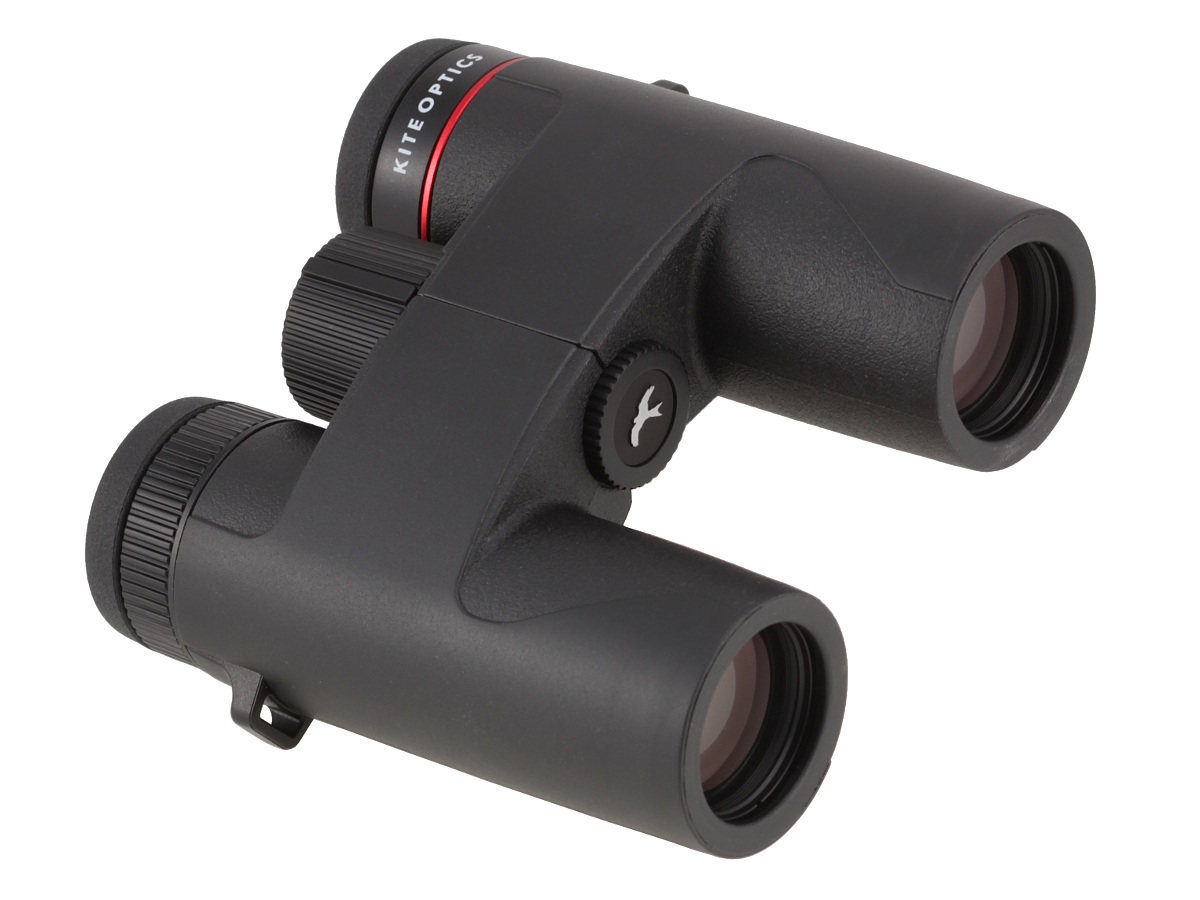
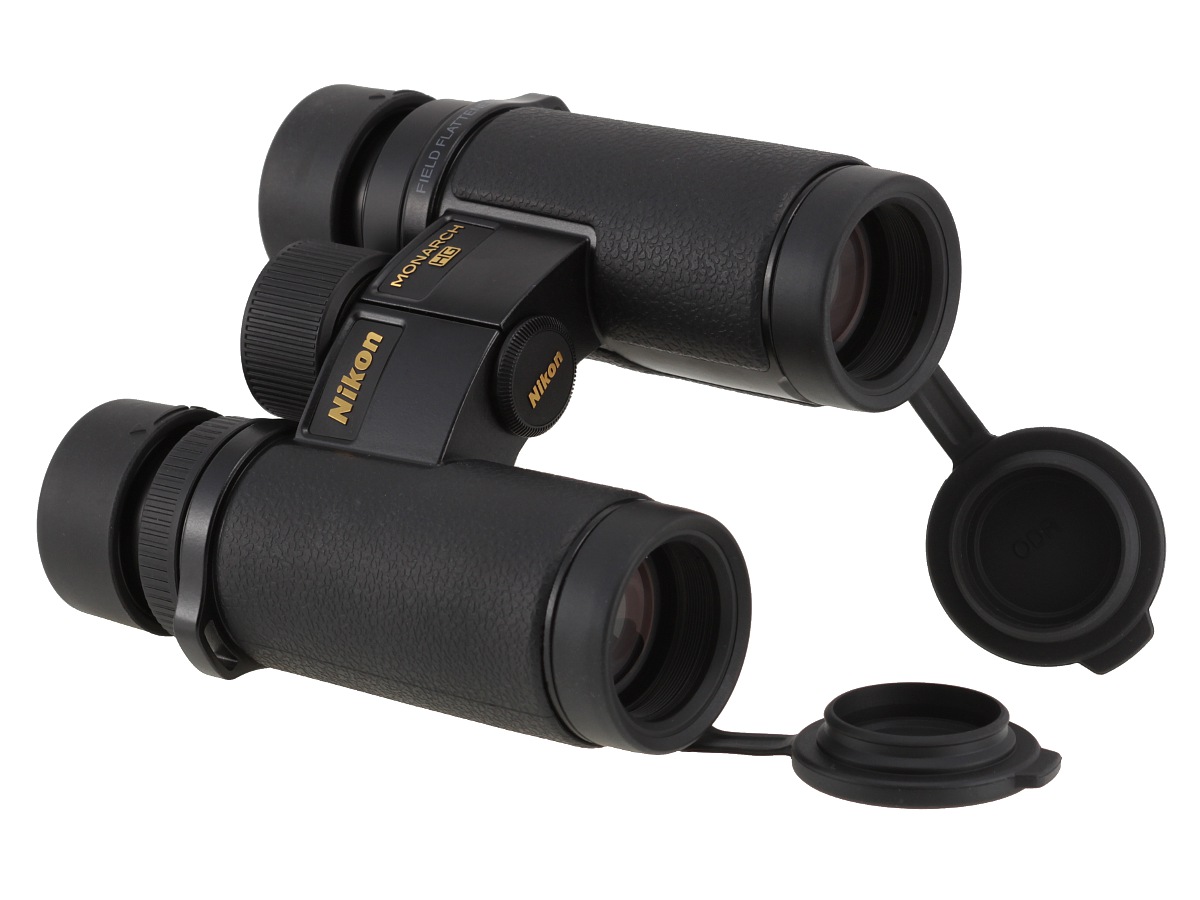
When it comes to build quality and the materials used in these binoculars, there are no weak performers here. Operating in the upper price segment, all players claim compliance with the highest standards. The three most expensive models feature magnesium alloy composite bodies, with only the most affordable - the Kite Lynx - mentioning metal elements and glass-fiber reinforced polycarbonate. Each chassis is nitrogen-filled and waterproof, though they differ in how their waterproofing is specified and the depth of protection offered.
Nikon leads the pack, offering waterproofing down to 5 meters for up to 10 minutes. Tied for second place are Swarovski, rated for immersion down to 4 meters, and Zeiss, with a 400 mbar rating (equivalent to a 4-meter water column). The Kite comes in last with an IPX7 rating, which guarantees protection against leaks when submerged to a depth of 1 meter for up to 30 minutes.
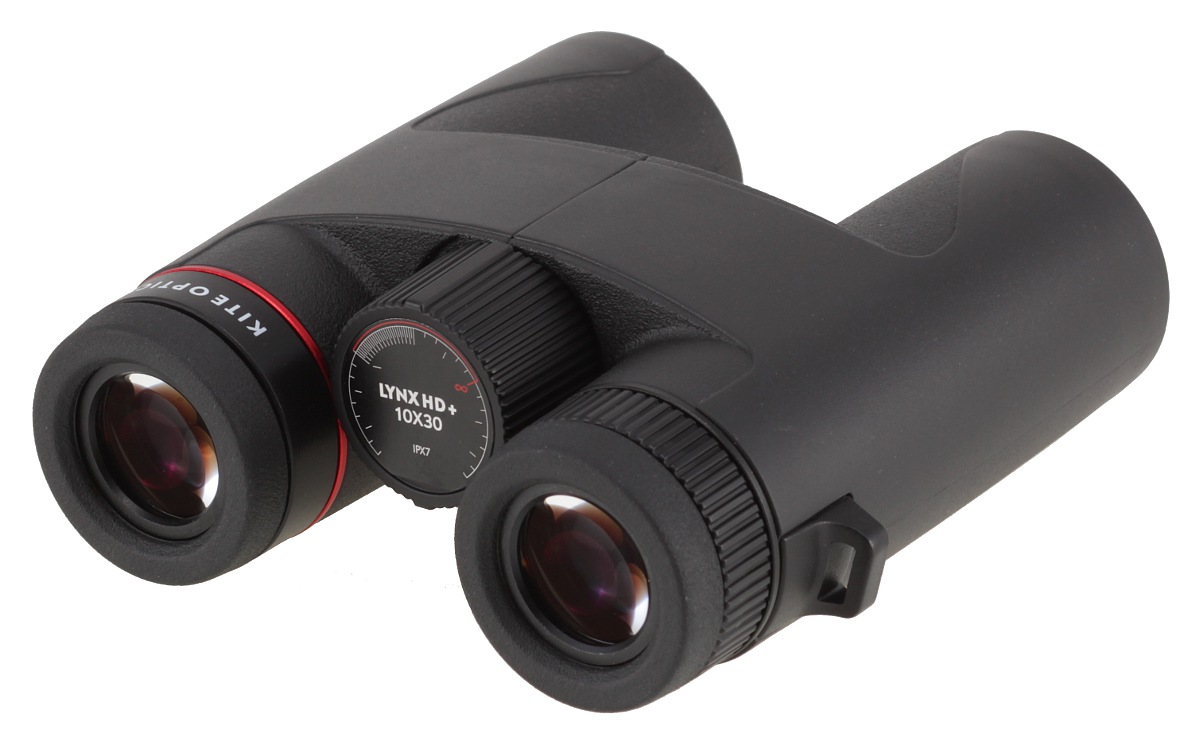
The rubber armor on the Kite’s body is black and matte, featuring a smooth finish in some areas and a fine texture in others. It adheres extremely well overall, though it can be lifted with relative ease right around the objective lenses. The central focusing wheel is comfortable to use, but resistance is noticeably firmer when turned clockwise than counterclockwise. A full focus move across the entire range requires a 380-degree turn. Diopter adjustment is handled by a well-designed, knurled ring on the right eyepiece, which operates smoothly and properly. The eyecups are short and rubberized, measuring 39 mm in diameter, with four distinct click-stop positions.
 |
Nikon’s central focusing wheel is likewise sizable and knurled, but it operates with firmer and more uniform resistance. Here, full focus travel across the entire range requires a turn of about 390 degrees. The diopter adjustment ring is equally convenient, but adds a locking mechanism: to adjust it, you must pull the ring upward. The Monarch’s eyecups look beefier than the Kite’s, though their diameter at the eye side is actually slightly smaller at 38 mm. They offer four click-stop positions.
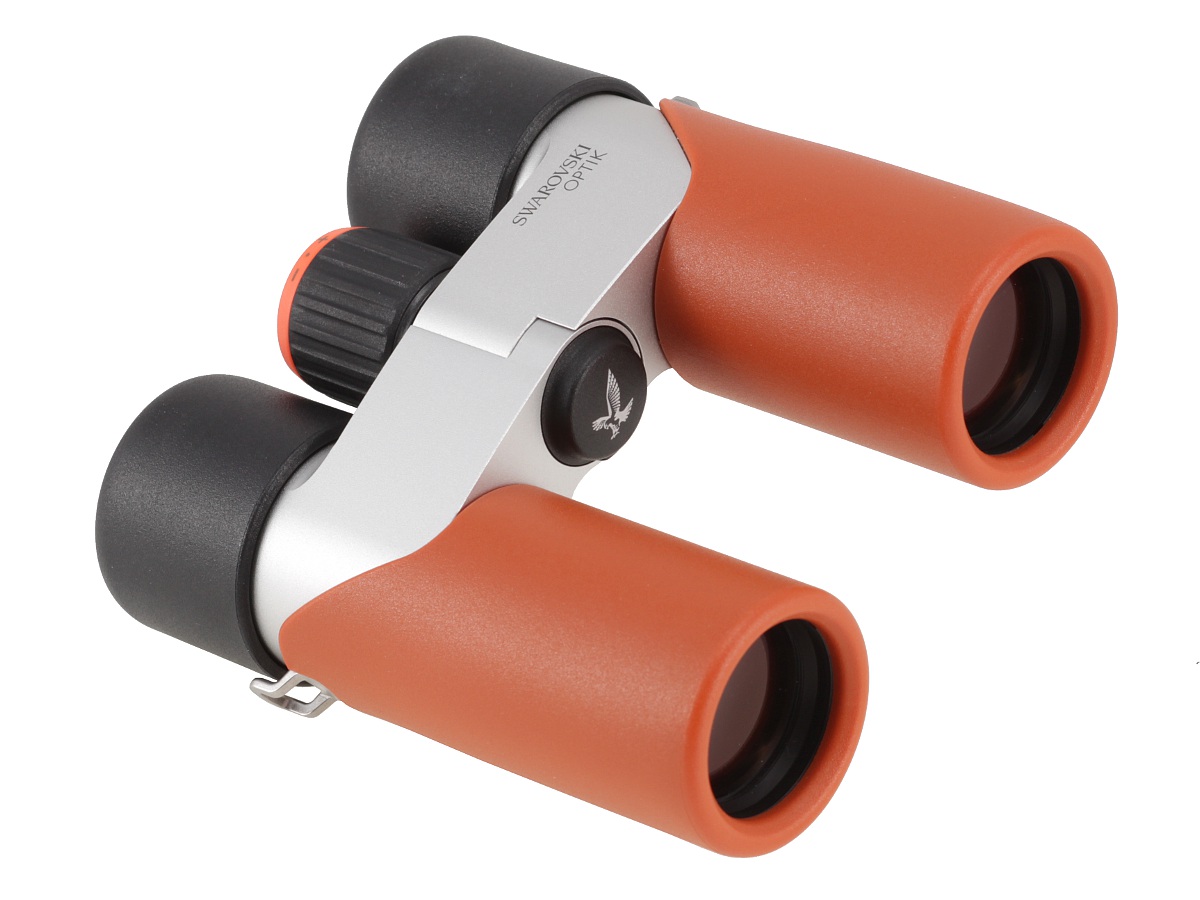
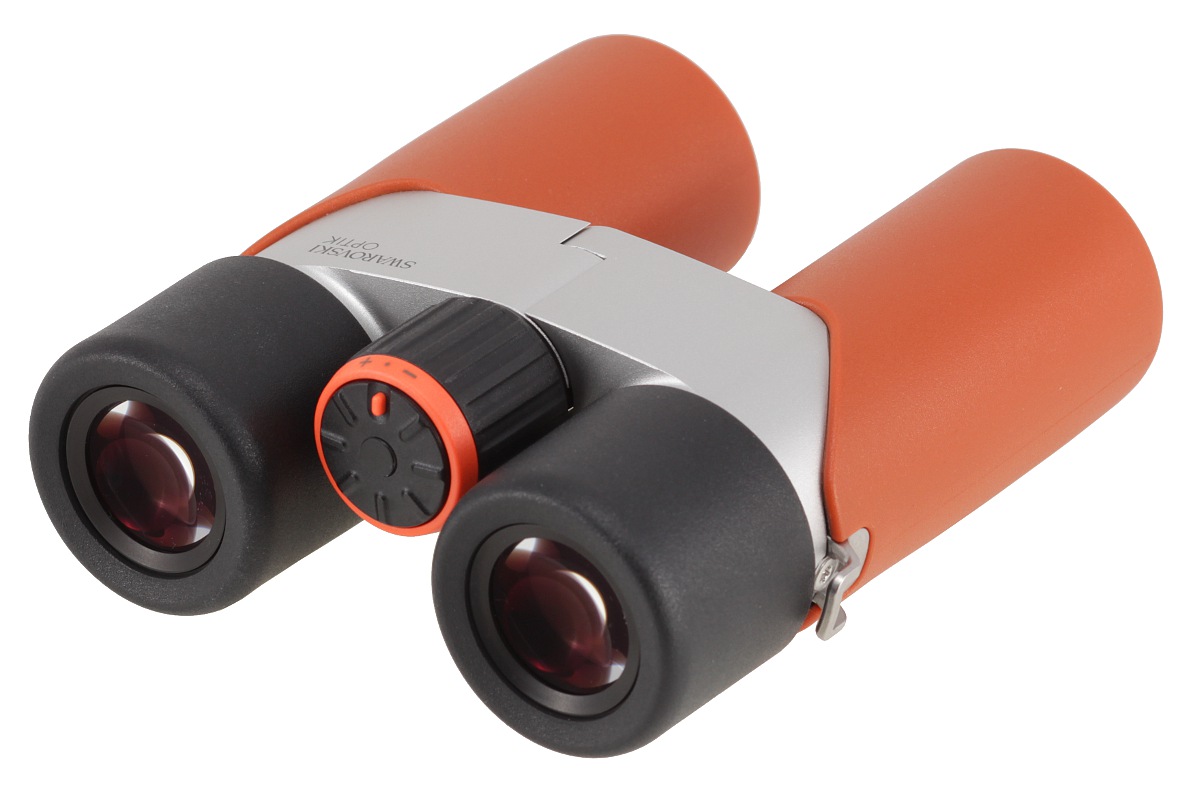
The body of the CL Companion 10x30 III appears bulky, but this is mainly due to how the eyecups are attached - they sleeve over the barrel rather than extending out from within it. As a result, they have a wide diameter of 43 mm, though thanks to good ergonomic shaping, they cause no discomfort against the eye. Their adjustment is stepless, allowing you to set them at any position.
The rubber armor has a very fine texture and does not cover the entire binocular, as the bridge is left exposed metal. However, the rubber adheres exceptionally well to the whole chassis, including the objective rims.
By contrast, the central focusing wheel is smaller than those on the Kite and Nikon, though still comfortable. It operates with light yet acceptable resistance, but at times feels as though it is catching on something, introducing slightly increased friction. While minor and sporadic, this flaw should not occur in a instrument of this class. You also have to turn it considerably more than on the previously discussed binoculars, as full focus travel requires a 550-degree rotation.
Diopter correction on the Swarovski is executed by pressing an integrated dial on the central focusing wheel. This is the most sophisticated and weather-sealed solution, as no optical element moves externally.
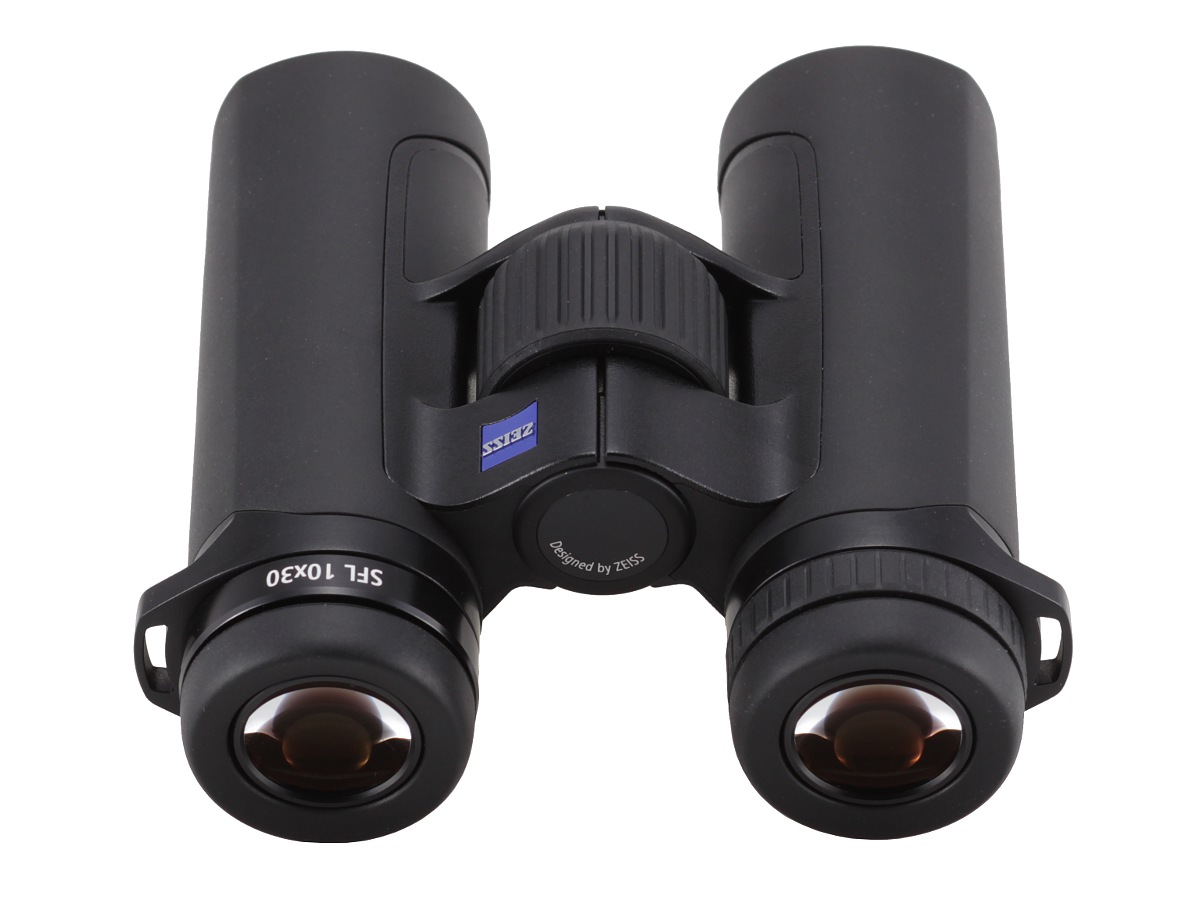
The rubber on the Zeiss SFL 10x30 features a very fine texture and covers the middle and outer portions of the barrels. The inner sides of the barrels and the bridge are bare metal. The rubber adheres very well to the chassis, lifting only slightly near the objective lenses when pried with extra force.
The eyecups are rubberized, compact, and slightly tapered at the ends, where their diameter measures 38 mm. They can be set in four click-stop positions.
 |
Another aspect worth examining is the interior of the optical barrels and the area surrounding the prisms in each model.
On the Kite, the inner barrels are very dark and matte, featuring plenty of ridging/baffling. The bottom housing around the prisms is dark, but their side walls are quite clearly visible and suspiciously bright. In terms of cleanliness, however, it is exemplary - we were unable to spot even the tiniest speck of dust.
The Nikon’s inner barrels are equally dark and matte, while featuring even more internal baffling. However, the ring surrounding the prisms is gray and slightly reflective - an area where there was room for improvement. On the left prism, a few isolated dust specks can be seen.
On the Swarovski, the upper section of the barrels near the objective lenses is dark and matte, but completely devoid of baffling. Baffles only appear further down in the sleeve below the focusing lens. The base and the area around the prisms are exceptionally well blackened, but a closer look reveals a significant quality control oversight: a fairly large piece of lint/fuzz is stuck near the edge of the right prism. Something clearly slipped past quality control here.
The Zeiss barrels are black, matte, and rich in internal light baffles and ridging. The prism base is dark, though the ring above them is gray - it could afford to be darker. Cleanliness is good overall, with only meticulous inspection revealing literally a couple of tiny dust specks.
In this comprehensive category, where the binoculars competed across several fronts, it is difficult to point to a single clear winner or loser. However, first place goes to the Nikon. It boasts the highest waterproof rating, its chassis showed no manufacturing flaws, and its interior blackening is executed properly. Second place belongs to the Zeiss, which conceded to the Nikon essentially only in its waterproofing level. Third place goes to the Swarovski, which dropped one to two positions due to the dirt flaw and the uneven focusing wheel movement. Last place falls to the most affordable model, the Kite, which features the lowest water resistance, the highest amount of plastic in its housing, the least secure rubber armor fit, and the weakest internal blackening around the prisms.
 |
Field of view
One of the primary advantages of the 10x30 and 10x32 classes is the large apparent field of view provided by their eyepieces. For many years now, this segment has featured models with fields ranging from 65 to 70 degrees. Our four test binoculars also fit within this range, though that by no means implies there are no differences between them.According to manufacturer specifications, the Swarovski has the smallest field of view at 6.6 degrees, while the remaining three models all claim an identical value of 6.9 degrees. We made sure to verify these claims, measuring the actual field of view for each binocular with a margin of error within 0.03 to 0.05 degrees.
The Companion’s result proved to be perfectly aligned with its specs, coming in at exactly 6.59 degrees. Its rivals, however, stretched the truth slightly, as none of them reached the declared 6.9 degrees. That said, the discrepancies are minor and fall right around the 2–3 sigma threshold, so there is little reason for harsh criticism here.
Formally, the Nikon recorded the highest result at 6.81 degrees, followed closely by the Zeiss, where our measurement showed 6.78 degrees, while the Kite yielded the smallest figure among the three at 6.75 degrees. Since all three of these results fall within our margin of error, we cannot crown a single definitive winner. We can therefore consider this trio to share first place, with the Companion placing just behind them.
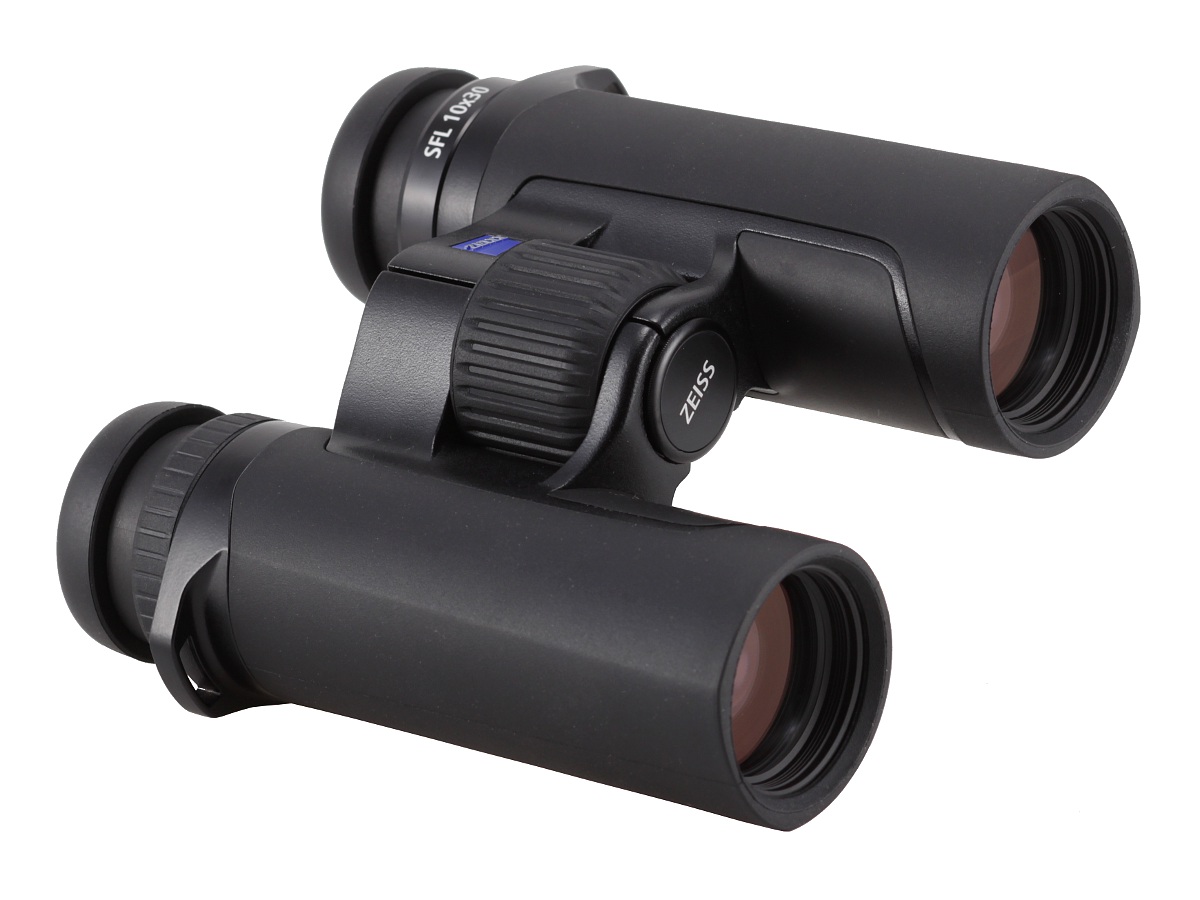 |
Image resolution
In this category, it is fairly easy to point out the model that finished in last place - the Kite Lynx. It lagged behind its competitors under every condition in which our testing was conducted.The remaining trio went virtually neck and neck. During daylight testing, it came down to subtle nuances. The test was carried out in summer, when heat shimmer likely influenced the assessments, as the ranking fluctuated constantly. To guarantee objective conditions, I headed to our editorial office and tested the binoculars using professional resolution test charts. Once again, the competition was fierce, but a conclusive verdict was reached. The Zeiss and Nikon put on the best performance, followed closely by the Swarovski, with the Kite bringing up the rear.
As for edge sharpness, all four binoculars employ field flatteners in their eyepieces, making for another tightly contested round operating at a very high level. The Nikon appeared to edge out the competition slightly, with the rest following close behind at a comparable level.
Thus, the final ranking for image sharpness is as follows: Nikon, Zeiss, Swarovski, Kite.
 |
White balance and contrast
In this category, picking a winner was fairly straightforward. The Zeiss outshone its competitors in both natural color rendering and image contrast. Looking through these binoculars, it is remarkably difficult to spot any color cast, and only after extended observation will you manage to notice subtle hints of red.
Second place goes to the Swarovski. Its image contrast is almost on par with the Zeiss, though its color fidelity falls slightly short. Here, it is easier to notice that the image is not perfectly neutral white, but carries a subtle yellowish-green tint.
Third place goes to the Nikon. While its image contrast leaves nothing to be desired, the green, yellow, and even mild orange undertones are more pronounced than on the Companion.
Last place once again falls to the Kite. Its color cast, characterized by warm cream and orange notes, may not be worse than the Nikon’s, but its overall lower contrast gives the image a noticeably grayer appearance.
 |
Chromatic aberration
Chromatic aberration was tested both at the center and at the edge of the field of view, with testing conducted at night (using the Moon two days before full) as well as during the day (using a bright white object against a black background).At the center of the field, the Nikon and Zeiss performed best, displaying very low levels of aberration - though it remained subtly perceptible under high-stress conditions. The Swarovski fared slightly worse, while the Kite brought up the rear.
Toward the edge of the field, performance dropped off significantly across the board. Only the Nikon managed a result close to average, while all the remaining models exhibited noticeably more pronounced aberration.
As a result, the Nikon leads this category, followed by the Zeiss, then the Swarovski, with the Lynx coming in last.
 |
Distortion
Distortion is not a serious issue for any of the tested binoculars. With complex eyepiece optics featuring field flatteners at their disposal, the manufacturers were also able to handle geometric distortion effectively.The Swarovski performed best in this category, exhibiting virtually zero distortion. At the same time, its moderately sized field of view avoided the rolling ball effect, making observations of moving objects entirely comfortable.
Second place goes to the Kite, which shows minimal pincushion distortion. Tied for third place are the Zeiss and Nikon, where this minimal pincushioning was just a fraction more pronounced.
 |
Night tests
Conducting night tests covering astigmatism, coma, and edge vignetting was a pure pleasure with these binoculars, as every single model put on a very good to excellent performance.The Zeiss SFL proved to be the true master here. Pinpoint star images were sharper than on any competitor, coma posed no issues even right at the field stop, and edge vignetting was barely noticeable.
Second place goes to the CL Companion, which also corrected astigmatism exceptionally well, though pinpoint stars flared just a touch more than on the Zeiss. Edge vignetting was likewise slightly more pronounced than on the Zeiss, while coma issues remained minor - though it did exhibit the so called "Absam ring" effect, where coma peaks not at the very edge of the field, but within a ring just inside it.
Next comes the Monarch, which ranked third for astigmatism control, second for coma, and tied with the Kite at the bottom of the group for edge vignetting.
Fourth place in this category goes to the Kite, which showed the highest level of astigmatism (though still low on an absolute scale), displayed the most prominent coma, and shared the highest edge vignetting with the Nikon.
Ghosting and flares
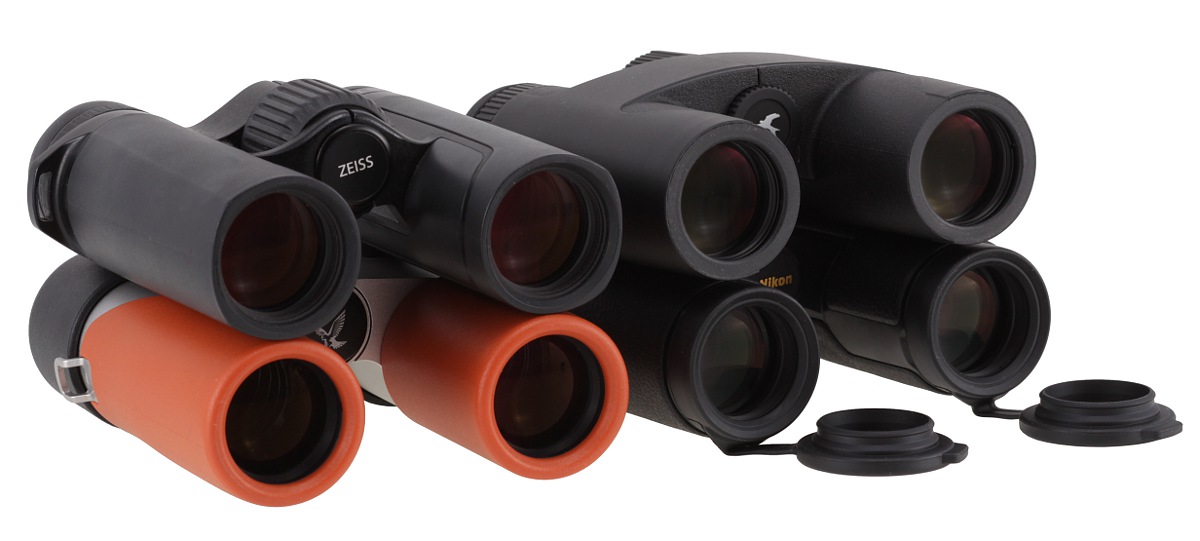
Even a quick glance at the exit pupils and the surrounding area (see pictures below) reveals that we have both a clear leader and an equally obvious outsider.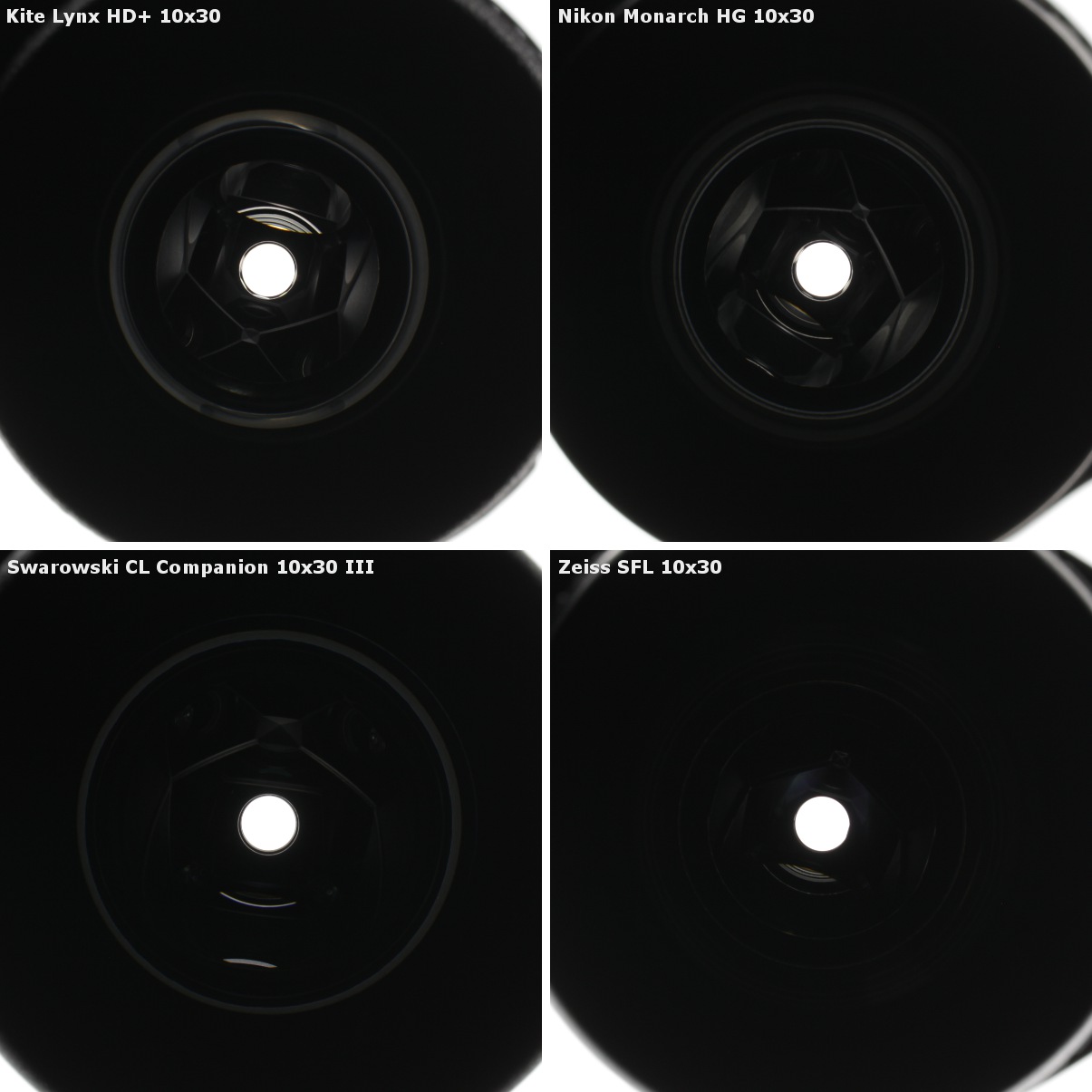 |
I happened to discover how a head-to-head match between the Zeiss and Swarovski in this category might play out somewhat by chance while filming a video for YouTube at the Beafoto store. We were sitting in the studio behind a table covered with optical and photography gear, with a large, bright softbox positioned right in front of us and slightly overhead. As it happened, the new Companion and the Zeiss SFL were lying side by side on that table. In those conditions, the former failed spectacularly, showing a marked, overall drop in contrast, whereas the Zeiss performed significantly better.
That somewhat accidental test was later confirmed under real conditions. At night, facing the Moon or bright streetlights, the SFL performs almost flawlessly. Contrast loss, ghosting, and spikes are truly minimal and sporadic. Second place goes to the Nikon, which generally renders a similar image to the Zeiss, though its overall contrast is slightly lower. On the Swarovski, small ghost reflections also appear, moving across the field of view as you pan. The situation is visibly at its worst on the Kite Lynx HD+, where in addition to ghosting, you encounter pronounced cross-shaped diffraction spikes that can get quite unsightly, especially around bright streetlamps.
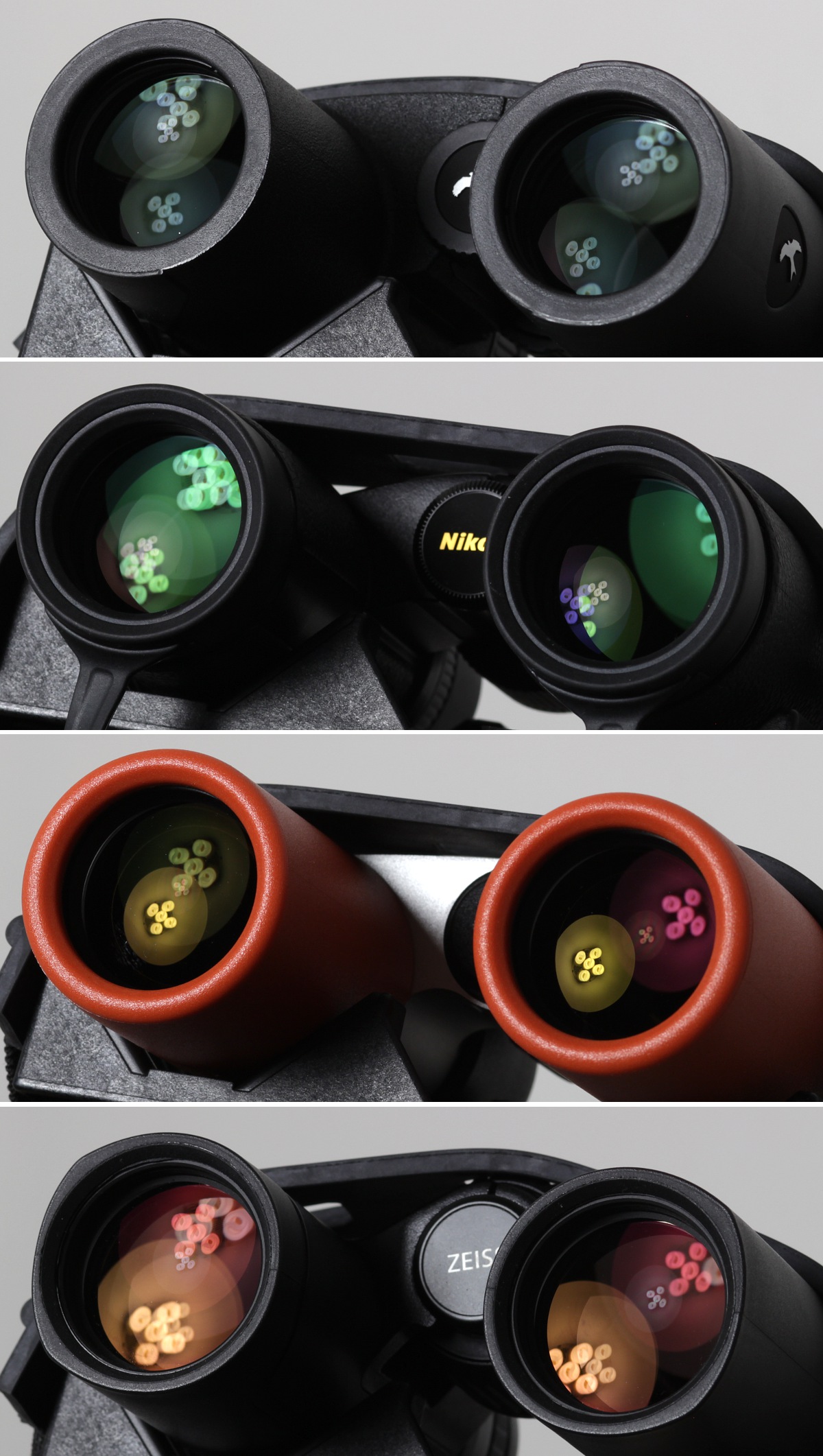 |
There is no doubt whatsoever that the Zeiss performed best here, while the Kite placed last. Second place goes to the Nikon, and third to the Swarovski.
Final results
The summary of results in all testing categories you can find in the chart below.
| Category | Kite Lynx HD+ 10x30 | Nikon Monarch HG 10x30 | Swarovski Companion CL 10x30 III | Zeiss SFL 10x30 |
|---|---|---|---|---|
| Specifications | 2 | 3 | 1 | 4 |
| Built quality | 1 | 4 | 2 | 3 |
| Field of view | 3 | 3 | 1 | 3 |
| Image resolution | 1 | 4 | 2 | 3 |
| Color and contrast | 1 | 2 | 3 | 4 |
| Chromatic aberration | 1 | 4 | 2 | 3 |
| Distortion | 3 | 1.5 | 4 | 1.5 |
| Night tests | 1 | 2 | 3 | 4 |
| Ghosting and flares | 1 | 3 | 2 | 4 |
| Result | 14.0 | 26.5 | 20.0 | 29.5 |
Although overall all four binoculars can be considered very good instruments, the results of our test are unambiguous and present a very clear ranking. The undisputed winner proved to be the Zeiss SFL 10x30, which successfully combined a solid, weather-sealed, yet sleek and lightweight chassis with a wide, exceptionally well-corrected field of view, comfortable eye relief, and a close focus distance of just 1.35 meters.
Second place comes as something of a surprise, as I had expected the Swarovski to be the Zeiss's main competitor; instead, the silver medal went to the significantly cheaper Nikon Monarch HG 10x30. For me, this was a double surprise. Nearly two years ago, when my wife was choosing a new pair of binoculars, we went to Beafoto and held a small side-by-side shootout between our then-current Zeiss Conquest HD 10x32, the Nikon Monarch HG 10x30, and the Zeiss SFL 10x30. Back then, we unanimously declared the Nikon to be the weakest of the trio, lagging noticeably behind the SFL.
Now, having conducted this shootout again with different copies of both the SFL and the Monarch, the gap between them felt considerably smaller than before. It is entirely possible that this is down to sample variation, which occurs to a small extent even in the highest price and quality tiers. Another explanation is that Nikon may have introduced subtle modifications over the past two years - such as tweaked anti-reflection coatings (a silent update practice known to be common among manufacturers) - thereby boosting the performance of its flagship compact lineup. Following the discontinuation of the 32 mm EDG models, the Monarch HG series stands as the Japanese manufacturer’s top-tier compact binocular offering, which carries certain expectations.
While the Zeiss SFL manages to hold off the Monarch’s advances, the third-place finisher - the third-generation Swarovski CL Companion 10x30 - faces a serious problem. It is noticeably more expensive than the Nikon, larger, heavier, less robustly weather-sealed, offers a narrower field of view, has a longer minimum focus distance, and falls short in several optical categories. It wins on eye relief (which may matter to some eyeglass wearers), controls distortion marginally better, and scores higher in night testing. However, these advantages are modest, and in light of all the evidence, the Monarch emerges as a far more compelling proposition.
Last place in our test goes to the Kite Lynx HD+ 10x30, which was practically destined to come in last. It is the most affordable binocular here, typically priced around 700 Euro, with promotional deals dropping it below 600 Euro. As a result, it can be up to three times cheaper than the Zeiss or Swarovski, placing it in an entirely different price-to-performance category. Within its own class, it remains a highly successful instrument that is easy to recommend, particularly to buyers for whom a budget of around 500-700 Euro represents a firm upper limit.
 |