


Review of four 15x56 binoculars
12. Comments from Other Testers
For me, the undisputed winner of this comparison is the Sky Rover Banner Cloud, which put competitors costing 2-3 times as much firmly in their place. Among the tested models, it corrects chromatic aberration best, features the largest and best-corrected field of view at the edge, and avoided any major missteps. The ergonomics of the eyecups came as a pleasant surprise: while I found them quite problematic on smaller models in this series, on the 15x56 I was able to fit them comfortably into my eye sockets without issue. The very smooth operation of the focus wheel is an added plus. Minor flaws do exist, but its massive advantages and reasonable price tag more than make up for them. Kudos to the manufacturer.
The Zeiss Conquest HDX turned in a solid performance, but I expected better. A clear flaw is the high level of chromatic aberration, clearly visible even near the center of the field of view. Additionally, the test unit suffered from a defective focus wheel that operated very poorly. The Zeiss deserves praise for its good ergonomics, what I consider the most comfortable eyecups in the test, and superb resistance to glare and stray light. In other areas it performed well, but not exceptionally. At this price point, one can expect more.
Please Support UsIf you enjoy our reviews and articles, and you want us to continue our work please, support our website by donating through PayPal. The funds are going to be used for paying our editorial team, renting servers, and equipping our testing studio; only that way we will be able to continue providing you interesting content for free. |
- - - - - - - - - - - - - - - - - - - - - - - - - - - - - - - - - - - - - - - - - - - - - - - -
The Oberwerk Ultra ED left me with mixed feelings. Of all the binoculars tested, it arguably offered the sharpest image at the center, yet decisively the worst at the edge of its wide field of view. Individual eyepiece focusing and heavy weight significantly limit its versatility. I had hoped for slightly better performance from this model, but despite these flaws, it still offers good value for money.
The Swarovski SLC proved to be the biggest disappointment. It suffered a major setback when viewing against light - a frequent issue with the Austrian maker's optics, unfortunately. Good color fidelity alone is far from enough to justify such a high price, especially when it lost out to much cheaper rivals in other categories. With a budget of 2500 Euro, one would be far better off buying something less expensive or stretching for the outstanding NL Pure 14x52, which excels over the SLC in virtually every metric.
Which of these binoculars would I actually buy? Probably none of them. This test convinced me that the 15x56 configuration is simply impractical for my needs. These binoculars demand a tripod to unlock their full potential, whereas I prefer terrestrial observing handheld or off a monopod. As a result, I am currently weighing two alternatives: the Sky Rover Banner Cloud 12x56 for open-field birdwatching, and the Oberwerk Ultra ED 15x70 for sweeping the night sky.
 |
The test did not reveal a clear, singular winner for me, which shows just how difficult it is to engineer a high-magnification binocular with fully satisfying optics and ergonomics.
Having used high-magnification binoculars for long-distance observation for years, I expect them to deliver crisp, clear views of distant targets. In that respect, the winner of this test for me was the Zeiss Conquest HDX 15x56. Oberkochen's new coating technology combined with Abbe-Koenig prisms provided the greatest sense of image contrast and transmission, and thus central sharpness. I appreciate its faithful white balance alongside natural, unexaggerated color saturation - traits that rarely go hand in hand in high-contrast optics. Also noteworthy was its class-leading performance against stray light, providing a soothing sense of image clarity regardless of where you point it. On the downside is its heavy chromatic aberration, though I was able to manage it partially thanks to the ergonomically comfortable eyepieces.
I appreciate the immense technical know-how as well as the sheer size and edge correction of the Sky Rover Banner Cloud 15x56 APO's field of view, but once again, I simply couldn't get along with its sharpness. From my very first look through this 15x model, it felt as though the left and right optical channels delivered subtly different images - and it wasn't a matter of bad collimation. Otherwise, its contrast, chromatic aberration control, edge sharpness, and distortion control across such an enormous apparent field of view are of a very high standard, arguably matching the "Big Three."
The biggest disappointment of the test for me is the Swarovski SLC 15x56 W B - a binocular carrying high expectations that let us down first with collimation, and then underscored how its coating technology has stalled compared to newer rivals. It feels like all development efforts at the Absam factory are currently directed toward the NL Pure series.
As for the Oberwerk Ultra ED 15x56, the impression matched my expectations - an interesting Chinese Porro binocular whose development plateaued at the stage of the iconic BA8 series with low-dispersion glass. Every parameter here is at least good, but remains a step below the quality present in the competing roof-prism models. Likely in an effort to boost contrast (which is higher than what Chinese Porro models previously offered), Oberwerk opted for deep pinkish-violet coatings that reduce near-red and violet wavelengths, leading to a distinctly warmer image. On certain scenes where distant detail contains a lot of yellow or green (during our test, leaves on trees on the far bank of the Vistula river), this color shift can impair the perceived sharpness. I deliberately say "perceived" sharpness - the ease of discerning detail - rather than inherent resolution stemming from the precision of the optical system itself. Evaluating the latter properly would require a clear, starry night sky.
Which I warmly wish to every Reader of this review.
 |
In my opinion, the Sky Rover Banner Cloud 15x56 APO is a bino with very good contrast, color accuracy, and color saturation - a remarkably sharp binocular once you get used to it and position it properly against your eyes. This non-immediate access to an otherwise stellar level of sharpness, stemming from a narrow eye-position tolerance, is a characteristic trait of many Banner Cloud models, particularly those with higher magnifications. Subtle variances in optical correction between the two optical channels may also be present here.
The Zeiss Conquest HDX 15x56, despite strong attributes such as very high contrast and excellent performance against direct sunlight, disappointed me with excessive chromatic aberration. On our test unit, the focus wheel felt and operated as though it were broken. This is not the first misstep I have encountered on a new Conquest-series binocular; among other issues, I have seen unevenly rotating - and even unthreading - eyecups on a store display unit during normal adjustment.
I do not understand why a Swarovski SLC 15x56 W B sample sent directly from the manufacturer for testing arrived miscollimated well beyond factory tolerances. We have colleagues in the community who are very satisfied owners of this model, yet their buying history also includes receiving a brand-new, misaligned unit. This points to insufficient quality control at the factory. I cannot recall anyone reporting a similar issue after buying Swarovski's current flagship models. Fortunately, thanks to several SLC 15x56 owners, I had previously experienced this optic firsthand through units with pristine collimation. I must admit that those samples left nothing to be desired, delivering great ergonomics, effortless sharpness right when brought to the eyes, pleasing depth and color rendition, as well as glare-free performance against the sun.
The Oberwerk Ultra ED 15x56 gave me the impression of a solidly built, respectable astronomical Porro binocular that should satisfy many a night-sky observer. A binocular featuring individual focusing at 15x magnification with a minimum focus distance of 15 meters is hardly built for users conducting short-to-medium-range terrestrial observations. Naturally, aberrations that manifest primarily on stars - such as astigmatism and coma - could not be properly evaluated during a daytime test.
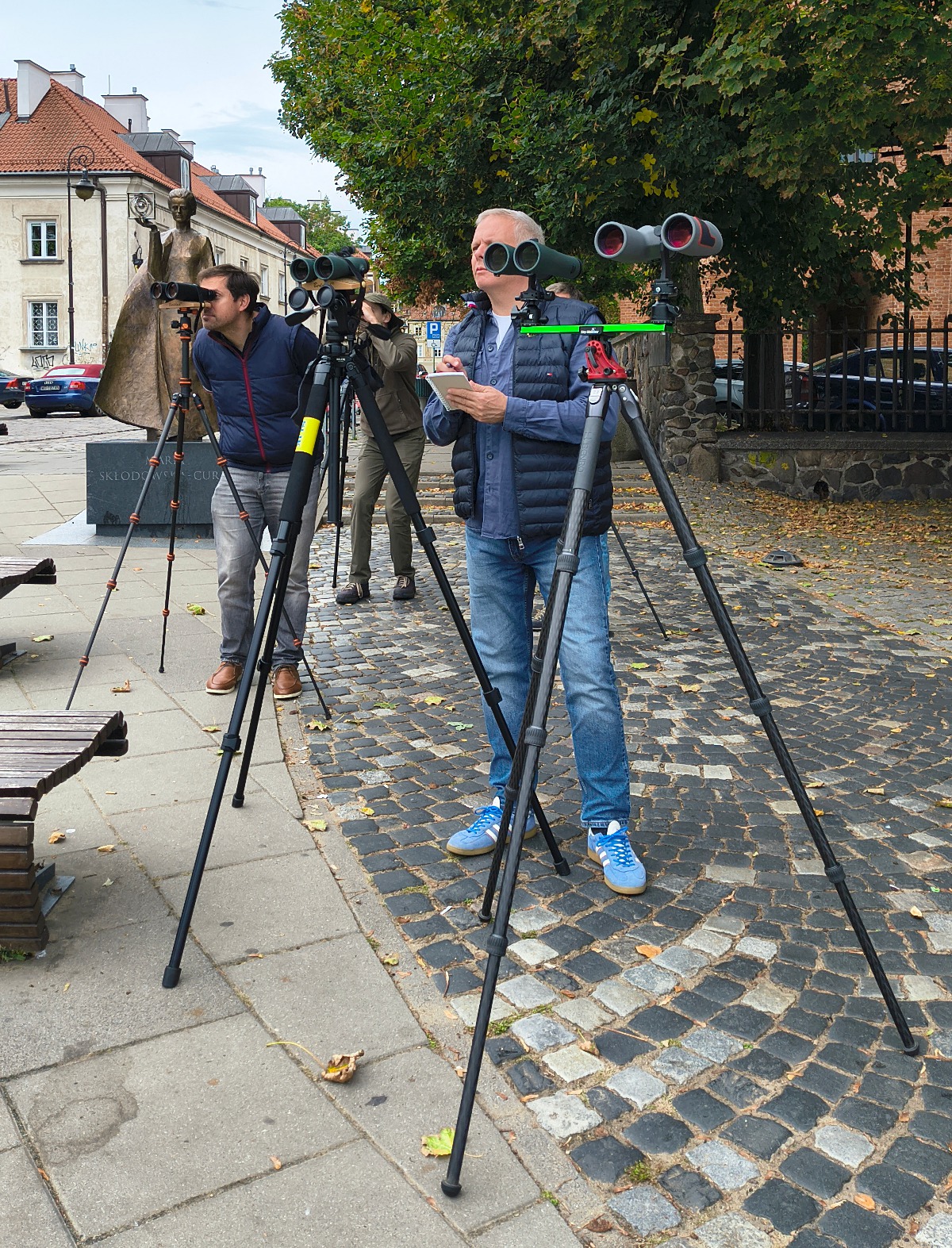
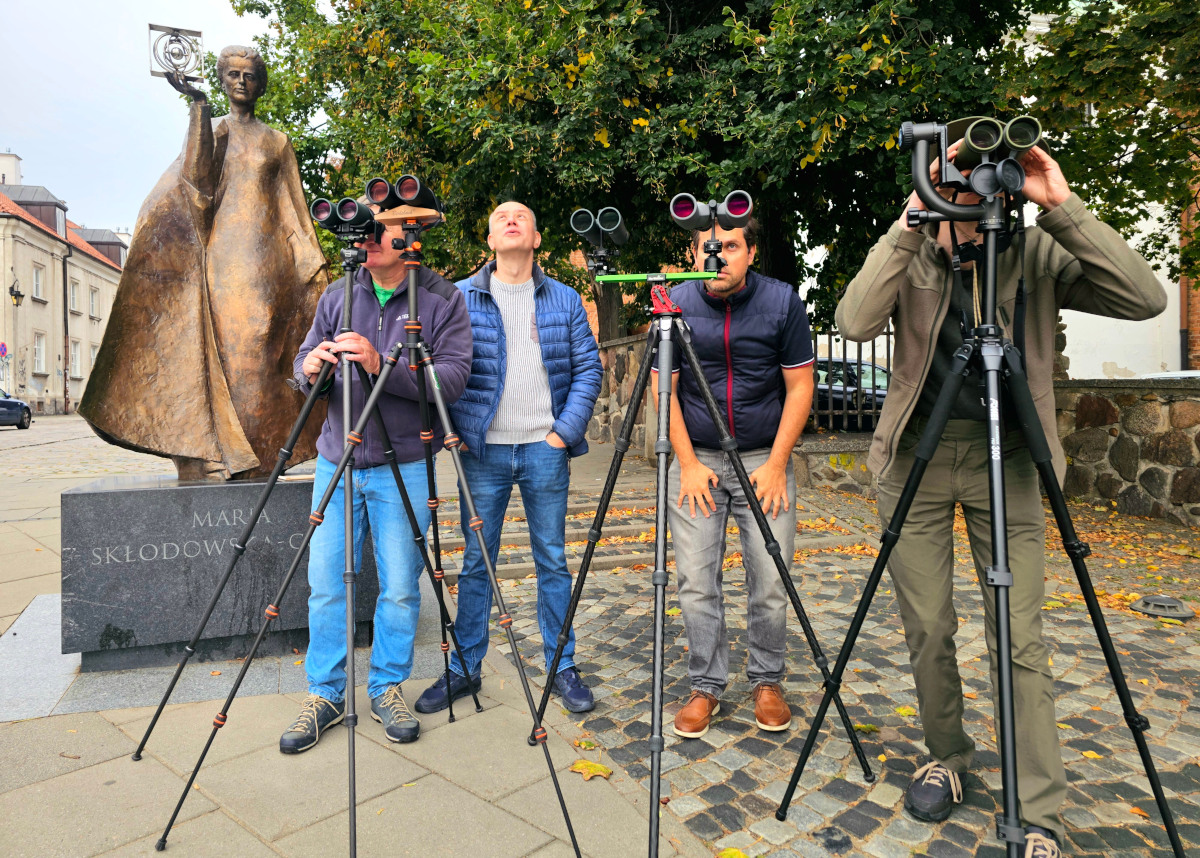
Testing binoculars on a tripod introduces unique demands and a hidden trap that needs to be recognized - one that might not be immediately obvious to someone who primarily observes handheld. That trap is the difficulty of maintaining precise eye alignment relative to the exit pupils. This applies both to aligning pupil distance with the binocular's IPD setting and to the angle at which you look through the eyepieces while standing in front of a tripod. Lacking the stable seal between face and eyecups that naturally occurs during handheld use causes the view to "float" around the sweet spot, creating optical artifacts that can catch you off guard - most notably, chromatic aberration appearing unexpectedly close to the center of the field, even when absent during handheld viewing. Haste is very counterproductive here; to obtain an accurate impression of the optics, you must patiently adjust the tripod height and IPD, and press the face firmly against the binocular after another tester steps away. I admit I underestimated this factor during our experiment.
Evaluating sharpness also brought to light something I hadn't fully realized before, which my colleagues pointed out. At the start of the test, all four binoculars were aimed at two neo-Gothic brick towers of the St. Florian's Cathedral in Warsaw-Praga - a target with fine details that seem ideal for testing sharpness. That holds true, but not necessarily at a distance of 1430 meters across a river, where atmospheric haze becomes significant. Under those conditions, sharpness differences between the binoculars blend together, making precise evaluation impossible. It was only when we redirected the binoculars toward the branches of a nearby tree that fine nuances in perceived sharpness emerged, allowing us to spot subtle differences between the models.