



How do we test binoculars?
1. Description of test methods and categories.
We try to test and write our reviews in the most meticulous and precise manner and we try to have a lot of fun as well. For such a group of binoculars enthusiasts the fact that you have an access to many excellent models produced by the most renowned companies in the world is really the source of pure enjoyment – a practical combination of work and fun. We are also in contact with those manufacturers constantly. That’s why our tests consist not only of work done in a photographic studio and a laboratory by an optical bench and a spectrophotometer. Field tests are an inherent part of every review – using a given pair of binoculars in practice, looking through it outside during the day and at night.
It’s worth mentioning here that our tests aren’t aimed at some special group of users. Our test categories and rankings have been constructed in such a way so all binoculars users can profit from them. You should never look blindly at just the numbers, though. Our task is to provide you some food for thought. If you want to use the material, published by us, in a way which is most perfectly suited to your needs the analysis must be done by every Reader on his or her own. Do not hesitate to omit these categories which don’t interest you or give different weights to particular results. Only such a creative approach will help you make a good, well-thought-out choice.
Please Support UsIf you enjoy our reviews and articles, and you want us to continue our work please, support our website by donating through PayPal. The funds are going to be used for paying our editorial team, renting servers, and equipping our testing studio; only that way we will be able to continue providing you interesting content for free. |
- - - - - - - - - - - - - - - - - - - - - - - - - - - - - - - - - - - - - - - - - - - - - - - -
You can ask one question here – whether you should trust implicitly all scores, presented in different test categories. The answer is no. All physical measurements are fraught with measurement errors, both systematic and statistical. These errors can be minimized and we try to do so, but you can’t omit them completely. It’s worth remembering that even if you state a given value along with its measurement error it is still not the end of the story. A transmission result amounting to 90.0% +\- 1.0%, according to the statistical laws (the so-called 1-sigma) means there is a 68% probability that the real value, measured by us, is within a range from 89 to 91%. There are also 32% of chances that value is lower than 89% or higher than 91%. You can also use 2-sigma or 3-sigma error measures to increase the probability of our value. In that example there is a 95.4% probability that our value is contained within a range from 88% to 92% and 99.7% sure that it is within the 87-93% range Still there remains 0.3% of chances it is outside that range.
Don’t forget about one more, very important issue. A pair of binoculars you intend to buy should be tested before the purchase. People’s eye sockets differ greatly so it is very important to check how well a given device fits your face and your hand. Sometimes it’s better to focus on an instrument which got a bit worse result in our test but its ergonomy suits you better than that of a supposedly better model.
Finally one more important piece of news. We usually borrow a pair of binoculars for about a month, two at most. Such a period of time allows us to test the optics meticulously and assess the mechanics in a preliminary way. It is definitely too short to say how a given device will fare after one year or several years of intensive usage. Here we have to depend on the opinions of our Readers. That’s why we would like to encourage everybody to enter our binoculars database and add your personal opinion about the product you use. Thank you in advance!
TRANSMISSION (15 points) - Currently we use spectophotometer to obtain the transmission graph in the range of wavelenghts from 380 to 900 nm. The method is very precise one and allows us to minimalize uncertainties to around 1%. In older tests we used three less accurate methods:
- We mount a high level digital camera to an eyepiece (ocular lens) and we take a picture of diode. Then after standard procedure of data reduction, we carry out aperture photometry by comparing diode brightnesses (measured by eyepiece + camera configuration). Results depend only on lens diameter (which we know) and light transmission (which we can count).
- We mount a high class CCTV video camera and record diverse luminosity star clusters (for example ‘Pleiades’) on a very starlit sky. The differences in range results from different transmission.
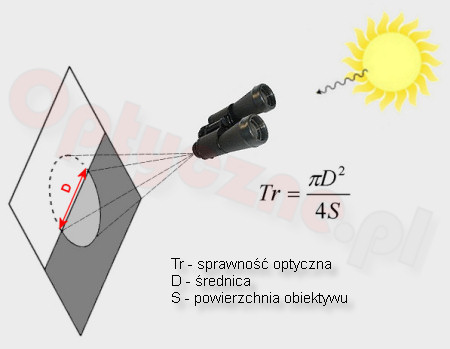
- Another method rests on projecting intensive sunlight onto shaded white screen. A part of this screen is directly sunlit and to shaded part we glue a ruler. The screen is located in a specific distance to line up and cover screen surface brightness with projected image of sunlight surface brightness. Now we take a picture of this projected image of sun by camera. The ruler let us measure the scale of taken picture. A proportion of measured sun image in relation to actual lens area gives us the transmission.
By doing many measurements and using independent methods, we estimate the precision of transmission estimate in range of 3-5%.
CHROMATIC ABERRATION (10 points) - The chromatic aberration is estimated by our own observations, setting a contrastive object in the center of the field of view and moving it to the corner. Depending on our observations, binoculars can get here from 0 to 8 points for the center performance and -/+ 2 points for behavior at the egde.
ASTIGMATISM (10 points) - We considered a level of astigmatism trying to achieve a perfect punctual image of stars. Then focusing in two different distances we measured the vertical and horizontal deformation in relation to spherical symmetry axis.
DISTORTION (10 ppints) - We arrange binoculars in opposite to the wall where we previously hung a graph paper. Several testers personally determine field of view tested binoculars and consider which line (from the central point) seem to be curved. Results are given in percent proportionally in relation to field of view radius.
COMA (10 points) - It is a spherical aberration referring to distortion of rays running through the lens at the corners. It deforms image of stars which look like V letter or appear to have a cometary coma, hence the name – coma. We measured it by moving the stars to the corners of binoculars field of view and estimated the size of the deformation and how far from the center it appears.
BLURRING AT THE EDGE OF FOV (10 points) - We arrange binoculars in opposite to the wall where we previously hung a lightened graph paper. Several testers personally determine field of view tested binoculars and focusing binoculars at the central field of view. Then starting from the central, most sharp point and moving to the corners they consider where on graph paper lines start to get fuzzy and blur.
EYEPIECES FOV (10 points) - We multiply an actual magnification by an actual field of view so that we could gain eyepieces apparent field of view.
HOUSING (8 points) - We evaluated: what kind of materials have been applied, how do binoculars behave in use, is it comfortable and ergonomic gripping, do elements move smoothly and are there any squeaks or clearances especially in the area of the front lens. We also checked the eyepiece shell, if it is comfortable when put eye against ocular, and of course the general observation comfort.
FIELD OF VIEW (8 points) - That is the test checking up the truthfulness of manufacturers. We arrange binoculars in distance from 6 to 15m in opposite to the graph paper. Several testers personally determined the field of view. Measurements were very precise that error of measurement was only about 0.02-0.04 degree. Afterwards we compared the actual results to manufacturers parameters. There were extra points possible to gain by an unusually large field of view – 2 points and additional 1 point for larger field of view than given by manufacturers.
REAL FRONT LENS DIAMETER (8 points) - That’s the another test of manufacturers truthfulness. Several tester measured personally lens diameter by slide calliper. We averaged the results achieving precision on 0.05 mm level. Front lenses could gain 4 points per each.
VIGNETTING AND PRISMS QUALITY (8 + 8 points) - We estimated how much gathering by lens light is wasted in too small or poorly arranged prisms. Does any mechanisms or internal instruments, supporting prisms, obstruct field of view? Are prisms made by Bk7 or BaK-4 glass and what is its quality? We measured the image of exit pupil using a digital camera and we measured precisely how much area of pupil is vignetting and dimness covered.
WARRANTY (6 points) - Convention of rating was like this: 0p. for less than 1 year warranty, 1p. for 1 year warranty, 2p. for 2 years warranty, 3p. for 3-5 years warranty, 4p. for 5-10 years warranty, 5p. for 10-30 years warranty and 6p. for longer than 30years warranty.
INTERPUPILARY DISTANCE (6 points) - The minimal and maximal interpupilary distance. It was rated as following: >=74mm – 5p., 73mm – 4p., 72mm – 3p., 71mm – 2p., 70mm – 1p., <=69mm – 0p. One extra point was possible to gain by minimal distance narrower than 50mm and one penal for minimal distance wider than 59mm. Maximum points to gain was 6.
COLLIMATION (5 points) - Poor tubes adjustment may cause viewer headache. Collimation was checked by choosing (at the centre field of view) faraway point (star or lighthouse). Then we distance binoculars against our eyes for about 20cm. 5 points so the maximal rate was gained by binoculars where there was no splitting up of image.
QUALITY OF THE INTERIOR OF THE BARRELS (5 points) - We evaluated quantity of dust and general impurity inside the binoculars by putting it against the glare light. We also evaluated materials quality intended for blackening the interior of binoculars and checked the quantity of glossy elements.
INTERNAL REFLECTIONS (5 points) - Binoculars should be perfectly blackened inside. In addition the image of exit pupil should be clear on the black background, without any reflections. That’s why we took images of pupil in dark room (using always the same exposure time and lighting conditions) whereas the binoculars were directed towards bright and regularly lighten white wall.
WHITENESS OF THE IMAGE (5 points) - We looked through every binoculars at white wall of building in the daylight and considered modifications of white color depended on given binoculars.
FOCUSING (5 points) - We checked how smoothly the eyepieces move. We subtracted points for too stepping and irregular ocular moves and possibility of getting out of adjustment by pushing on oculars. Besides we subtracted points for defects like leaking or freezing on cold lubricant.
DARKENING AT THE EDGE OF FOV (5 points) - All binoculars image quality is getting worse and worse when we move our sight to the edges field of view. The less intensive that effect is, the better binoculars are. Every tester personally checked transmission and quality on the edges by moving observing stars from centre to border field of view.
ANTIREFLECTION COATINGS (5 points) - Quality of antireflection coatings on the air-glass border; what is quality? how many light is reflected? We lighted up by glare light and evaluated color and quality of reflections.
REAL MAGINIFCATION (3 points) - The another manufacturers truthfulness test. We took pictures of open caliper which was put against pupil and checked is it the same as original parameters. We were able to measure exit pupil exact to 0.1mm. As far as we knew an actual lens diameter we gained the magnification exact to typical 0.2-0.3x measure error.
CLOSEST FOCUSING DISTANCE (2 points) - Considering binoculars with 8-10x magnification we granted 2p. for 5 and less meters, 1p. for 5-6.5 meters and 0p. for distance longer than 6.5 meters. Considering binoculars with 15-20x magnification we granted 2p. for 8 and less meters, 1p. for 8-11 meters and 0p. for distance longer than 11 meters.
How to understand the overall results of our tests? See a list below:
- 150 p. and more - perfection
- 140-149p. – outstanding result
- 130-139p. – excellent result
- 120-129p. – very good result
- 110-119p. – good result
- 100-109p. – middling result
- 90-99p. – not so good result
- 80-89p. – poor result
- 70-79p. – bad result
- under 70p. – pathetic result


